 ‘The currency of real networking is not greed, but generosity.’ (Keith Ferrazzi) One of the skills in Action Learning is to distinguish between a presenter who is wrestling with a question from one who has become completely stuck. In the former case, it’s often most useful simply to sit with the presenter in silence while the question does its work. In the latter, the facilitator may offer the presenter an option of ‘peer-consultancy’, if it might help break the mental deadlock. In order to do this well, however, and to ensure that ownership and agency remain with the presenter, the facilitator can follow a specific sequence of interventions and process steps:
A few words of caution. First, beware of introducing the peer-consultancy approach without checking in with the presenter first. If the presenter is deep in thought, such a shift in approach may feel premature of patronising, as if inferring that they’re unable to work out a solution for themselves. Second, beware of any formal or informal (e.g. age, gender, race) hierarchical dynamics in a group. Presenters may feel that they ought to respond to all insights out of respect for those who shared them, or obliged to agree with ideas proposed by someone they regard as an authority figure.
8 Comments
 ‘Revolution starts in the mind. Question everything.’ (Bryant McGill) If – a tiny word, one of the shortest in the English language – framed as a question, can open up a whole array of possibilities. It can raise insights and ideas into awareness by presenting a hypothesis that stretches the imagination and creates the potential for breakthrough. Used in coaching, consultancy and action learning, it can help shift a conversation beyond the what-is to the what-could-be; from a place of stuck-ness towards radical and liberating solutions. Posed in invitational, coactive tone: ‘If we were to have a really useful conversation, what would we be talking about?’ ‘If we were to introduce this change, what would it mean for you?’ ‘If we were to move ahead with this, what would you need?’ ‘If you were to do this with confidence, what would you be doing?’ ‘If you were to be successful in this venture, what would that make possible?’ ‘If you had a good-enough answer to this question, what would it be?’ If you were to draw more on the power of ‘if’, what difference could that make?  ‘Without transition, a change is just a rearrangement of the furniture.’ (William Bridges) Lean forward and look into the room. Listen in carefully to the conversation. An organisation has decided to move to smaller and cheaper office premises in order to reduce its overheads. It will mean agile working: a shift to hybrid working, hot-desking and staff lockers. It appoints a change team to oversee the move, and the team notices a range of responses from staff, from passive apathy to active dissent. It faces a growing concern about what it perceives as resistance to change. It tries hard with corporate communications to let staff know what will happen when and yet is increasingly bemused and anxious about the apparent lack of buy-in. The team invites me in as an external organisation development (OD) consultant to have a conversation with staff, an open exploration of issues and how to move things forward. Here’s a glimpse and summary, following initial rapport-building and relational-contracting to ensure a felt-sense of safety and trust in the room:
The change team had focused on practical changes (physical-transactional: what happens around us) and inadvertently failed to pay attention to corresponding human transitions (psychological-emotional: what happens within us). Notice the flow of the consultant conversation: from feeling, to meaning, to need, to solution. The style is invitational, enhancing the felt-sense of choice, influence and agency. Baskets are provided. Staff re-engage. The move goes ahead smoothly. [See also: Change leadership principles; Organisations don't exist]  ‘I’m not a teacher, but an awakener.’ (Robert Frost) I imagine something like a coffee table between us. As the client talks about a challenge, issue or opportunity they are dealing with, I imagine them metaphorically painting a picture on the table, perhaps adding something like colourful photos from magazines, to depict their situation vividly. If, as a coach, I allow myself to follow the client’s gaze, to focus my own attention too on the scenario that is unfolding, I risk losing sight of the client. It may weaken the contact between us; draw us both into the place where the client already feels stuck; diminish the potential for transformation. How can I know if this is happening, if I have inadvertently become preoccupied with or seduced by the drama the client is presenting? Here are some tell-tale signs: ‘Tell me more about…’; ‘I’d be interested to hear more about…’; ‘Could you share a bit more of the background..?’ It could be that the client’s issue resonates with an area of interest, expertise or experience of the coach; or that the coach has subconsciously slipped into diagnostic-consultant mode, with a view to finding or creating a solution for the client. It’s as if, ‘If you give me enough information, I can resolve this for you.’ A radically different approach is to hold our attention on the client, to be aware of the figurative coffee table in our peripheral vision, but to stay firmly focused on the person (or team) in front of us. This is often where the most powerful coaching insights and outcomes emerge. Here are some sample person- (or team-) orientated questions: ‘Who or what matters most to you in this?’; ‘What outcome are you hoping for?’; ‘As you talk about this now, how are you feeling?’; ‘What assumptions are you making?’; ‘What are you not-noticing?’; ‘What are you avoiding?’; ‘Now that you know this, what will you do?’  An opportunity to receive questions. ‘Swap your difficulties, not your cleverness.’ (Reg Revans) You may have heard of Action Learning – a powerful tool used in organisations and between peers to learn in the context of action, and act in the context of learning. It typically involves one person presenting an issue, and then receiving critical questions from peers that enable them to think it through for themselves and reach their own solutions. In this sense, we could think of a conventional Action Learning process as a group-team of individuals providing coaching-consultancy to an individual. I saw this idea turned on its head on a trip to Africa. An organisation was grappling with key strategic issues and invited leaders and professionals to form Action Learning sets to address them. Instead of one person presenting, however, the groups first spent time clarifying and crystallising their own issues. They then asked of themselves and each other: What are the critical questions that, if we could answer them, would provide us with strategic options? They finished by reaching agreement on solutions. It’s the first time I had seen Action Learning used as a collective venture in this way. It was a a shared, relational process of inquiry, ownership and problem-solving wherein the group itself functioned simultaneously as both client and coach-consultant. I have seen similar patterns of approach used in Asia since. What strikes me is that this isn’t just a different, novel methodology or technique. It’s the product of a deep cultural mindset, belief and stance that sees, values and places the group first. In my experience, there are corresponding benefits and risks to working in these different ways. An individual-orientation can develop personal insight, awareness and autonomy yet may lack ‘the whole is greater than the sum of the parts’ strength and cohesion in addressing change. A group-orientation, on the other hand, can bring the latter advantages to bear, yet faces its own risks including social loafing, conflict-avoidance or group-think. I’m curious, therefore: what have been your experiences of Action Learning? 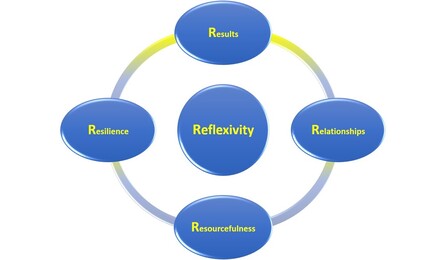 People sometimes ask if I have a guiding framework for fields of practice that range from individual and team coaching to organisation development. To be honest, it’s difficult to pin down definitively without becoming simplistic. After all, we work with people, cultures, systems and contexts that are dynamically complex. Different people, situations and times call for different interventions. Here-and-now presence, openness, curiosity and trust are prerequisite conditions for successful outcomes. That said, I often hold 5 x Rs in mind as potential areas for attention. Each R represents a different and inter-related dimension of experience, awareness and practice that commonly influences a client’s inspiration and effectiveness. The Rs are: Results, Relationships, Resourcefulness, Resilience and Reflexivity (sometimes known as ‘critical reflective practice’ or ‘praxis’). I may explore and apply these dimensions with a client at different levels ranging from intra/inter-personal to organisational. Results focuses on who or what is most important to a client and other key stakeholders and taps into e.g. vision, values, purpose, strategy, plans and outcomes. Relationships focuses on the quality of client contact with and between key stakeholders and taps into e.g. ethics, cultures, systems, synergies and dependencies. Resourcefulness focuses on solutions, strengths and opportunities in the client/environment and taps into e.g. spirituality, talent, creativity, innovation and networks. Resilience focuses on client health, wellbeing and sustainability and taps into e.g. motivation, engagement, patterns-trends, agility and flow. Reflexivity focuses on the client’s critical self- and situational awareness, stance and actions and taps into e.g. assumptions, constructs, influences, behaviours and decisions. I place the latter at the centre of this model because, at best, it radically questions, challenges and guides all other dimensions. It lays at the heart of transformational change. What frameworks do you use and find most useful? I worked with a leadership team recently where we experimented with reframing statements from problems-focus to solutions-focus to see what would happen if we did. The team had been grappling with difficult issues for some time which had led some to the near-resigned conclusion that there was little hope of change. I wondered whether part of the challenge and resulting mood lay in the psychological-linguistic framing of the issues rather than, necessarily, in the issues themselves.
I was curious and invited the team to be curious too about how the issues were being perceived, construed and articulated within the team – a kind of team self-talk, if you like. If someone said, ‘X will not work because of Y’, we experimented with reframing the statement as a question instead, e.g. ‘Given Y, what would it take for X to work?’ It shifted the conversation from a definitive, closed end to an open, curious, exploration of new possibilities and ideas. It created fresh energy too. I’ve worked with some clients where a person may comment that, for instance, ‘X is a good idea in principle but it would never work here.’ It’s often a response from someone who has worked a long time in the same place, has been around the proverbial block a few times or is starting to feel a bit jaded. I try to tune into the mood, acknowledge the underlying feeling and then reframe it: ‘OK, so what would work here?’ or, perhaps, ‘If X is a good idea, what would it take for it to work here?’ In my experience, solutions-focus works best when done in an open (e.g. prayerful) spirit, eliciting values (what matters to you – to motivate), creative visioning (what do you/we hope for – to inspire), appreciative inquiry (what’s working well – to build on) and affirming strengths (what are you/we good at – to draw on). Positive appraisal of the present with optimistic aspiration for the future lead well into: ‘So, what would need to happen for that to happen?’ and, ‘The next step?'  I took part in a workshop last week that focused on social media, work and leadership. One of the questions that Zoe Amar, the trainer, posed was, ‘What’s your personal brand?’ It was in relation to being clear and authentic about, say, who we are, what makes us distinctive, what others value about us, what we have to offer etc. I quickly thought about my own Twitter, LinkedIn and website profiles. How clear and consistent am I in how I portray myself, what is true about me and what matters to me, bearing in mind the different audiences and purposes for those profiles?
The phrase ‘psychological coach’ sprang to mind. ‘I’m a psychological coach’. I also do mentoring, training, facilitation, consultancy, writing and even some teaching yet, somehow, ‘psychological coach’ felt the clearest and most grounding. Perhaps it’s something about how I see myself, what I enjoy, what expertise I hold, where I feel my calling lays, where clients say I add value, how I see and approach what I do. The psychological part signifies a type, a focus, a style, an orientation to my work' the coaching part signifies developing and releasing hope and potential in others. What this means in practice is that I tend to view and approach leadership, mentoring, training, facilitation, consultancy etc. through a psychological lens. I instinctively look at what enhances or inhibits people, teams, groups and organisations from psychological, existential and systemic perspectives. I draw on insights and practices from fields as diverse as social constructionism, Gestalt/field theory and cognitive behavioural psychology. I enable people, teams, groups and organisations to grow in insight and ability to create, achieve and sustain their transformation. So – ‘I’m a psychological coach’. Inspired by my Christian faith and informed by my studies and experience, it’s at the heart of who I am in the world, my work, what I do and how I do it. What’s your personal brand? When teams are under pressure, e.g. dealing with critical issues, sensitive topics or working to tight deadlines, tensions can emerge that lead to conversations getting stuck. Stuck-ness between two or more people most commonly occurs when at least one party’s underlying needs are not being met, or a goal that is important to them feels blocked.
The most obvious signs or stuck-ness are conversations that feel deadlocked, ping-pong back and forth without making progress or go round and round in circles. Both parties may state and restate their views or positions, wishing the other would really hear. If unresolved, responses may include anger/frustration (fight) or disengagement/withdrawal (flight). If such situations occur, a simple four step process can make a positive difference, releasing the stuck-ness to move things forward. It can feel hard to do in practice, however, if caught up in the drama and the tense feelings that ensue! I’ve found that jotting down questions as an aide memoire can help, especially if stuck-ness is a repeating pattern. 1. Observation. (‘What’s going on?’). This stage involves metaphorically (or literally) stepping back from the interaction to notice and comment non-judgementally on what’s happening. E.g. ‘We’re both stating our positions but seem a bit stuck’. ‘We seem to be talking at cross purposes.’ 2. Awareness. (‘What’s going on for me?’). This stage involves tuning into my own experience, owning and articulating it, without projecting onto the other person. E.g. ‘I feel frustrated’. ‘I’m starting to feel defensive.’ ‘I’m struggling to understand where you are coming from.’ ‘I’m feeling unheard.’ 3. Inquiry. (‘What’s going on for you?’). This stage involves inquiring of the other person in an open spirit, with a genuine, empathetic, desire to hear. E.g. ‘How are you feeling?’ ‘What are you wanting that you are not receiving?’ ‘What’s important to you in this?’ ‘What do you want me to hear?’ 4. Action. ('What will move us forward?’) This stage involves making requests or suggestions that will help move the conversation forward together. E.g. ‘This is where I would like to get to…’ ‘It would help me if you would be willing to…’. ‘What do you need from me?’ ‘How about if we try…’ Shifting the focus of a conversation from content to dynamics in this way can create opportunity to surface different felt priorities, perspectives or experiences that otherwise remain hidden. It can allow a breathing space, an opportunity to re-establish contact with each other. It can build understanding, develop trust and accelerate the process of achieving results.  It was an energising experience, facilitating a group of leaders this week who are keen to build a new high performing team. We pushed the boundaries of normal ways of working to stimulate innovative ideas in all aspects of the team’s work. We used photos to create an agenda and physically enacted people’s aspirations to avoid falling into conventional patterns of heady, rational conversation. It felt very different to meeting ‘because that’s what we do’. There was a different dynamic, energy and momentum. Participants leaned actively into the conversation, not leaning back in passivity or boredom. Yet it can be a real challenge to break free from tradition, from norms that trap a team in ways of doing things that feel familiar and safe but, deep down, lack inspiration or effectiveness. In our meetings, how often do we pause before diving into the agenda to ask, ‘What’s the most important thing we should be focusing on?’, ‘How are we feeling about this?’, ‘What is distracting us or holding our attention?’, ‘What could be the most creative and inspiring way to approach this?’, ‘What do we each need, here and now, to bring our best to this?’, ‘What would be a great result?’ So I presented a simple model to the team with four words: content (what), process (how) and relationship (who) encircled around goal (where). In all my experience of working with individuals and teams, whether in coaching, training or facilitation, whether in the UK or overseas, these four factors are key recurring themes that make a very real difference. They seem to be important factors that, if we get them right, make a positive impact. They lead to people feeling energised, more alive, more motivated and engaged. Conversely, if we get them wrong, they leave people frustrated, drained of energy, bored or disengaged. Worse still, if left unaddressed, they can lead to negative, destructive conflict that completely debilitates a team. We can use a simple appreciative inquiry to reflect on this.‘Think back to your best experience of working with another person or team. How did you feel at the time?’, ‘Think back to a specific example of when you felt like that with the person or team. Where were you at the time? What were you doing? What were they doing? What made the biggest positive difference for you?’ One of the things we notice when asking such questions is that different things motivate and energise different people. That is, of course, one of the tricky parts of leading any team. So a next question to pose could be something like, ‘What would it take for this team to feel more like that, more of the time for you?’ and to see what the wider team is willing to accommodate or negotiate. Now back to the model with some sample prompts to check out and navigate with a client, group or team. Notice how the different areas overlap and impact on each other. It’s about addressing all areas, not just to one or two in isolation. However, having explored each area in whatever way or level suits your situation, you are free to focus your efforts on those that need special attention. Goal: ‘What’s your vision for this?’, ‘Why this, why now?’, ‘What are you hoping for?’, ‘What would make a great outcome for you?’, ‘What would be the benefits of achieving it or the costs of not achieving it?’, ‘Who or what else is impacted by it and how?, ‘Where would you like to get to by the end of this conversation?’, ‘An hour from now, what would have made this worthwhile?’ Content: ‘What’s the most important issue to focus this time on?’, ‘What is the best use of our time together?’, ‘What is the issue from your perspective?’, ‘How clear are you about what this issue entails?’, ‘What feelings is this issue evoking for you?’, ‘What do we need to take into account as we work on this together?’, ‘Do we have the right information and expertise to do this?’ Process: ‘How would you like to do this?’, ‘What approach would you find most inspiring?’, ‘What might be the best way to approach this given the time available?’, ‘Which aspects to we need to address first before moving onto others?’, ‘What would be best to do now and what could be best done outside of this meeting?’, ‘Could we try a new way that would lift our energy levels?’ Relationship: ‘What’s important to you in this?’, ‘What underlying values does this touch on for you?’, ‘How are you impacted?’, ‘How are you feeling?’, ‘What are you noticing from your unique perspective?’, ‘What distinctive contribution could you bring?’, ‘What is working well in the team’s relationships?’, ‘What is creating tension?’, ‘How could we resolve conflicting differences?’ The versatility of the model is that it can be reapplied to coaching, training and other contexts too. In a training environment you could consider, for instance, ‘What are we here to learn?’ (goal), ‘What material should we cover?’ (content), ‘What methods will suit different learning styles?’ (process) and ‘How can we help people work together well in this environment?' (relationship). In a coaching context it could look something like, ‘How do you hope to develop through engaging in this coaching experience?’ (goal), ‘What issues, challenges or opportunities would you like to focus on?’ (content), ‘How would you like to approach this together?’ (process) and ‘What would build and sustain trust as we work on these things together?’ (relationship). I’d be interested to hear from you. Do the areas represented in this model resonate with your own experiences? Which factors have you noticed tend to be most attended to or ignored? Do you have any real-life, practical examples of how you have addressed these factors and what happened as a result? In your experience, what other factors make the biggest difference? |
Nick WrightI'm a psychological coach, trainer and OD consultant. Curious to discover how can I help you? Get in touch! 
Like what you read? Simply enter your email address below to receive regular blog updates!


|
 RSS Feed