 ‘You could start a fight in an empty room, mate.’ (Allan Jones) I’ve never sought conflict. Far from it. I much prefer harmony and peace. That said, however, I can’t escape a similar calling to that which Martin Luther King once heard: ‘Stand up for righteousness! Stand up for justice! Stand up for truth!’ It’s a call that burns deeply inside of me and has done, as far as I can remember it, for my entire life. I’m pained to admit that I haven’t always followed that voice anywhere near as courageously as MLK. I haven’t always handled it with his astonishing humility and love. I’ve stayed silent when I should have spoken up or spoken up when I should have stayed silent. My words have stumbled out clumsily. I’ve caused pain where I meant to bring healing and hope. Yet, at times, this vocational stance has proved authentic, valuable and worthwhile. In my 30s, I worked for a large UK charity in the health and social care sector. As an idealistic young radical, I challenged the leadership team on numerous occasions when I believed we were compromising our values. I tried to do this with prayer and humility and out of a genuine desire to build relationship and trust. On one occasion, the leadership team decided, in view of limited budget, to increase only senior leadership salaries until it had secured sufficient funding to increase frontline staff salaries too. I argued vociferously that we should do the exact opposite – and to freeze my own salary as a first step. On another occasion, the leadership team decided to reserve all spaces in its small head office car park for executives only, given that they didn’t have time to drive around to look for parking places elsewhere. I advocated passionately that, especially in the winter months, the spaces should be reserved for female and other vulnerable staff or visitors so that they wouldn’t have to walk along dark city streets at night to their cars. On yet another occasion, the leadership team recruited a ‘hatchet man’ on temporary contract to implement a tough restructure with associated redundancies. I protested that this blunt way of approaching the change would damage relationships, engagement and trust. At times, I imagined my challenges and counter-proposals were met with deafening silence or heavy sighs – especially as I wasn’t a senior leader at the time. Nevertheless, when a serious crisis broke out between the leadership team and entire middle management, both sides to the conflict invited me to mediate as ‘the only person they could trust’. The chief executive, a man of remarkable humility, took me into his confidence and treated me like a respected thought-partner. When I moved on, the company secretary wrote to me to say he had never encountered such integrity. Even the dreaded ‘hatchet man’ wrote that he wouldn’t hesitate to employ me alongside him in any future role. Pray with humility – take a stance – speak the truth in love.
16 Comments
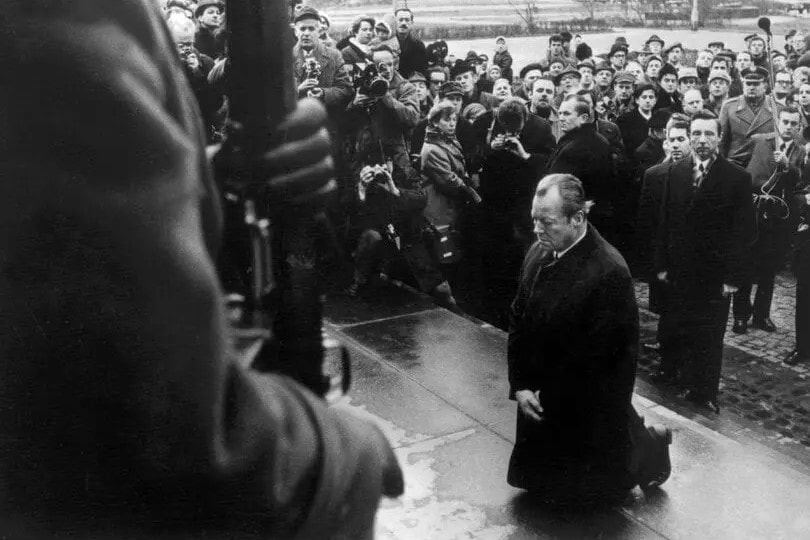 ‘To the victims of violence and betrayal, in the hope of an enduring peace.’ (Willy Brandt) Angelika gave me a gift this year of a shiny German 2 Euro coin. It was minted in 2020 to commemorate 50 years since West German Chancellor Willy Brand’s legendary ‘Kniefall’. I had heard of Willy Brandt but, I must confess, not the act that has, since, gripped my imagination. The German word Kniefall means, quite literally, to fall to one’s knees. I’m especially indebted to Valentin Rauer’s exceptional social-psychological study, Symbols in Action (2009), of what took place in that extraordinary moment in world history. I’m curious about what it meant and what made it so powerful. Brandt visited Warsaw in Poland, 25 years since the end of World War 2, on a mission to seek post-war reconciliation. Poland, including its Jewish population, had suffered horrific genocidal brutality at the hands of the Nazis. At the Monument to the Heroes of the Jewish Ghetto Uprising (against their Nazi oppressors in 1943), with a crowd of media reporters watching, Brandt suddenly and unexpectedly fell to his knees. He stayed there, in silence, as those around him looked on in amazement. It was an astonishing example of an action speaking far louder than words. At a political level Brandt, as Chancellor, represented West Germany. At a personal level, during the war, Brandt had been an anti-Nazi activist. The imagery of Brandt’s Kniefall, as an act of penitent humility that acknowledges guilt and seeks ‘forgiveness for an unforgivable past’ (Rauch), resonated deeply in a prevailing Christian culture. The symbolism of ‘the innocent (who) takes up the burden of the collective’s sin, thus redeeming the nation’ (Rauer) reflected Jesus Christ’s death on the cross. Brandt was in the square from which Jews were deported to concentration camps. For me, the most striking and moving dimension of this event was Brandt’s own reflection on the spontaneity and authenticity of his act: ‘Faced with the abyss of German history and the burden of the millions who had been murdered, I did what people do when words fail us.’ It paints the picture of a human being, beyond the public trappings of a politician, who allowed himself to feel empathy and brokenness, to take undefended responsibility and to reach out in peace. It transformed the trajectory of Cold War politics then. How desperately we need leaders like that now.  ‘It’s a question of what the relationship can bear.’ (Alison Bailie) You may have heard the old adage, the received wisdom that says, ‘Don’t try to run before you can walk.’ It normally refers to avoiding taking on complex tasks until we have mastered simpler ones. Yet the same principle can apply in relationships too. Think of leadership, teamworking, coaching or an action learning set; any relationship or web of relationships where an optimal balance of support and challenge is needed to achieve an important goal. Too much challenge, too early, and we can cause fracture and hurt. It takes time, patience and commitment to build understanding and trust. I like Stephen Covey’s insight that, ‘Trust grows when we take a risk and find ourselves supported.’ It’s an invitation to humility, vulnerability and courage. It sometimes calls for us to take the first step, to offer our own humanity with all our insecurities and frailties first, as a gift we hope the other party will hold tenderly. It's an invitation, too, for the receiver to respond with love. John, in the Bible, comments that, ‘Love takes away fear’. To love in the context of work isn’t something soft and sentimental as some cynics would have us believe. It’s an attitude and stance that reveals itself in tangible action. Reg Revans, founder of action learning, said, ‘Swap your difficulties, not your cleverness.’ A hidden subtext could read, ‘Respond to my fragility with love, and I will trust you.’ I joined one organisation as a new leader. On day 3, one of my team members led an all-staff event and, afterwards, she approached me anxiously for feedback. I asked firstly and warmly, with a smile, ‘What would you find most useful at this point in our relationship – affirmation or critique?’ She laughed, breathed a sigh of relief, and said, ‘To be honest, affirmation – I felt so nervous and hoped that, as my new boss, you would like how I had handled it!’ In this vein, psychologist John Bowlby emphasised the early need for and value of establishing a ‘secure base’: that is, key relationship(s) where a person feels loved and psychologically safe, and from which she or he can feel confident to explore in a spirit of curiosity, daring and freedom. It provides an existential foundation on which to build, and enables a person to invite and welcome stretching challenge without feeling defensive, threatened or bruised. How do you demonstrate love at work? What does it look like in practice?  ‘I know that I know nothing.’ (Socrates) Action Learning is an opportunity to receive questions. It’s founder, Reg Revans, advocated: ‘Swap your difficulties, not your cleverness.’ Revans’ approach was a radically different philosophy and praxis that stood in contrast to conventional didactic methods at the time. It affirms the value of not-knowing, curiosity and exploration. It facilitates a grappling with questions that have no easy answers and creating experimental solutions; without a pressure to hide from or impress peers. A transformational dimension of Action Learning is the power of vulnerability in building trust. If I model an authentic openness, a willingness to share those issues and experiences that I find most perplexing or troubling in my own work, it may invite others, in Susan Scott’s words, to ‘come out from behind (themselves) and make it real’ too – if they choose it. Stephen Covey expresses this dynamic well in his insight that, ‘Trust grows when we take a risk and find ourselves supported.’ I like the questions that Angie Bamgbose poses to herself in her insightful Action Learning blog, Race, Power and Privilege: ‘What is my gift? What am I still confused about? What have I learned? What will I do?’ It models the spirit of courage, humility and reflexivity that lays at the heart of Action Learning practice. It reminded me of guru Rick James’ opening words at an INTRAC webinar this year, looking at the future of humanitarian work internationally: ‘There is so much I don’t understand’. How do you use questions to stimulate reflection, insight and action? How do you handle personal and cultural pressures to present a front, to impress or to ‘perform’? (See also: Not-Knowing; Managing our Not-Knowing; Action Learning)  ‘The opportunity to make effective personal choices is highly unequal.’ (Robert A. Dahl - After the Revolution) New Years’ Resolutions. A time and practice in Western cultures when some of the more reflective or impulsive among us will commit to do something new. It could be, for instance, a new relationship, a new job, a new home, a new diet or a new fitness routine. For many people, very soon after having made a decision, the resolve will dissolve and be lost in the mists of time. Yet central to this idea of resolution is the notion of personal choice and, with it, the principle that I can succeed in achieving what I choose – if I’m willing to do whatever it takes. I often create (prayerfully) a list of key aspirations at the start of each year, then put practical steps in place so that, all things being equal, I will be able to look back at the end of that year and see that I have fulfilled them. The goals are intentionally inspiring and stretching. They are, with God’s help, within my grasp and, therefore, possible. On the whole, this discipline works by ensuring focus, parameters and accountability. It also centres on people and things that are genuinely important to me and, thereby, taps into values, motivation and determination. We can think of this choosing-acting-influencing phenomenon as exercising personal agency. Shaun Gallagher describes this as, ‘the sense that I am the one who is causing or generating an action’. ‘I can choose’ is a profound existential, psychological and political statement and stance. It means I can break out beyond the apparent default of my circumstances. We hold the potential to be catalysts of real change in the world, within ourselves as well as in broader relationships and situations – and this brings opportunity and responsibility. I can choose and you can choose. I think vividly of Jasmin in the Philippines, a poor woman among the poor who chooses to follow Jesus’ call and example, whatever the cost. Rather than allowing herself to be limited by her circumstances or by expediency, she exercises radical personal agency and transforms everyone and everything in her path. Malala Yousafzai and Greta Thunberg are famous examples of women too who take personal choice, action and influence seriously – and, similarly, at considerable personal risk. There are wider dimensions. A person's sense and scope of agency are affected by structural factors that transcend the individual, e.g. social status; wealth; education; gender; ethnicity; culture. Mustafa Emirbayer and Ann Mische observed that a person’s lived experience limits what possible alternatives or future scenarios he or she is able to imagine. Paulo Freire proposed, on a similar basis, that critical consciousness (‘conscientisation’) is a necessary condition for people to exercise freer choices and agency for change. I worked with a client from Myanmar and asked her what she dreamed of. She looked at me blankly then responded that she was unable to conceive of a different reality to the one that she had lived until now. She felt crushed by the mental and practical constraints of living as an ethnic minority in a country dominated by a military dictatorship. The impact of unequal and unjust social-political power is not a fixed determinant of agency – but the stark psychological and tangible inequalities of choice and opportunity it engenders are significant. Other influences include personal confidence, competence and capacity. If a person operates psychologically and relationally from a secure base with trust and support, he or she is more likely to choose to take a positive risk. If, conversely, someone is and-or feels alone and has experienced or anticipates unfair discrimination, negative evaluation or other painful consequences, to act can feel hazardous – especially if the stakes are high. Agency can demand energy, courage and resilience. A person may not (yet) feel ready, willing or able to take that step. If a client is unaware of or avoiding personal agency, William Glasser suggests stimulating his or her sense of reality, responsibility and relationship in order to enable more life-giving choices. If stuck in a pattern of apathy or passivity, John Blakey and Ian Day propose offering high challenge with high support. If we risk inadvertently colluding with or disempowering a client, Reg and Madge Batten advise focusing attention on what the person can do for him- or herself and, only after that, what we could do by agreement with them, or on their behalf. Viktor Frankl, victim of Nazi persecution concluded that, fundamentally: ‘The one thing you can’t take away from me is the way I choose to respond.’ In our personal, social and political lives, we can see how a person’s choices, actions and influence are affected by a diverse range of factors. These include the privileges a person may hold (or not) and the opportunities he or she has benefited from by birth, background or context. Jesus – help me choose this year to exercise my own agency for the life and liberation of others. We can be hope. (Would you like to discover how to exercise greater personal agency? Get in touch!) 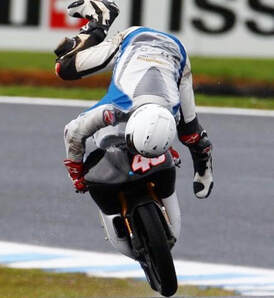 ‘Did you just fall?’ ‘No, I was checking if gravity still works.’ (Meggy Jo) ‘You are responsible for everything that happens to you.’ That’s a bit extreme, isn’t it? This was the opening line of some motorcycle training I signed up to last week. I have owned 24 bikes and been off 19 times but some of them definitely were not my fault. At least, I didn’t think so. The training is challenging me to think very differently about my own part in what happened – what I knew or didn’t know; what I was feeling; the various choices and decisions I made; the actions that led to a crash. This is similar to psychiatrist William Glasser’s ‘total behaviour’ in Choice Theory. Glasser proposes that everything we ‘do’ (i.e. thoughts; actions; feelings; physiology) is a dimension of chosen behaviour. He argues strongly that we have a high degree of direct control over our actions and thoughts and a fair degree of indirect control over our feelings and physiology. It’s a radical idea, offering a vision of far greater personal agency and responsibility than many of us would imagine possible. If I genuinely have choice over what I do, I am also capable of choosing something better. It means no more ducking and diving, attributing what happens in my life (or on my bike) solely to others or to circumstances. I can’t control everything, but I do have an influence over what happens next and how. This kind of awakening can feel liberating and scary, and often calls for real humility and courage. What are you willing to take responsibility for? How do you challenge and support choice in others?  ‘Come out from behind ourselves into the conversation and make it real.’ (Susan Scott) Hiding for fear of discovery is an archetypal characteristic of human beings. Think back to Adam and Eve in the Garden of Eden. Think too to an ex-colleague of mine who, employed as a police officer, donned his uniform every day and – strange as it may sound – spent his time impersonating a police officer. John Powell reflected this phenomenon well in his classic book, ‘Why Am I Afraid to Tell You Who I Am?’ It’s very often about fear of exposure, risk of rejection…imposter syndrome. There are, of course, at times good reasons to hide. I think, for instance, of criminals on the other side of the law who attempted last night to evade the blinding glare of a police helicopter searchlight outside a friend’s house. It was a dramatic scene, accompanied by the throbbing and deep reverberation of chopper blades overhead. We could think of such hiding as a rational and practical act – at least in the sense that it relates to a realistic prospect of arrest and imprisonment if caught. Yet we may find ourselves hiding for all kinds of other reasons too. Hiding often manifests itself in relationships and at work in subtle avoidance strategies. We may rationalise our hiding by telling ourselves that we can’t tackle a tricky person, a difficult issue, a daunting conversation, because we’re too busy, it’s not our job, they wouldn’t listen or it could make things even worse. In doing so, we may deprive ourselves and others of invaluable talent, trust, possibility – and hope. Stepping out takes courage with humility, challenge with support. When have you stepped out from behind yourself and made it real? When have you enabled others to step out too?  I have rarely witnessed such a humbling, authentic act of generosity. I was in the Philippines for the past 2 weeks visiting people and communities who are, by global standards, economically poor. The Filipina who accompanied me is poor too. She grew up in a remote jungle hut with no running water, electricity or sanitation. She works hard, long hours to support her children, family and community, determined that others should have better opportunities in life that she has experienced in her own. We were walking through an island village with children, teenagers and parents staring and smiling to see these strange visitors. The homes they were living in had only one room, no facilities, and we were passing a small hut with snacks hanging outside it on strings. It served as the village shop. We hadn’t eaten or had anything to drink for some time and the weather was hot and humid so I handed some money to my guide to buy herself some food. What happened next took me completely by surprise. This young woman bought all the snacks that were hanging there and immediately handed them to the intrigued children that had surrounded us. Then she walked around, handing them openly to mothers who were carrying toddlers – and toyed playfully with teenagers who wanted some too but were too shy to ask. The scene around us was transformed into one of spontaneous celebration with smiles everywhere and children running and laughing excitedly. It reminded me of Spirit, of incarnation, of Jesus. As we left the village with these images and sounds still dancing vividly in my mind, I commented to this special person, ‘You were amazing with them.’ She looked at me, wide eyed, and replied quite simply, ‘Nick – I am them.’ Those words detonated deeply in my soul. As leaders, OD and coaches, how far do we view staff, clients etc. as ‘them’, distinct from ‘us’? How would it impact on our presence, our behaviour, our effectiveness if we shifted our perspective, our stance, to one of radical identity with..? A good friend in the police service once commented how he would arrive at work each day, put on his uniform and spend the rest of the day ‘impersonating a police officer’. He had a clear idea in mind of how a police officer would typically speak and behave and so consciously acted it out. It was like playing a role in a theatre with the uniform acting as both costume and psychological prop.
A young girl working as a prostitute on the streets of Bangkok told me how she always used a pseudonym when working with clients. This name kept her real identity hidden and provided her with an alternative persona. By doing this, she was able psychologically to disassociate and protect her ‘true inner self’ from the separate persona that was engaging in sexual acts with strangers. A priest spoke of the pressures he felt to live a public life under constant moral scrutiny. By wearing a dog collar, he identified with a faith, a role and a calling that demanded high levels of personal integrity. Over the years, he struggled and found ways to live a more integrated and authentic life commenting that, ‘the real question is not how to be a priest but how to be oneself who is a priest.’ The first example here is of a person who found ways to fulfil a role by copying the behaviours of role models within that specific professional culture. The second is a person who learned to survive by deliberately separating herself psychologically from her persona-in-role. The third is a person who sought to find ways to live out a role by becoming more truly himself within that role. I’ve worked with numerous leaders who have experienced similar challenges. How to live and cope with one’s own expectations of leader and leadership as well as those imposed by the organisation or culture, not to mention the actual or imagined expectations of the board, peers and staff. It can feel stressful, daunting, isolating, debilitating and anxiety-provoking. It can result in burnout. Sometimes it’s a case of ‘impostor syndrome’ where a person believes he or she has been appointed to a role under some assumed false pretext or mistake. In such a situation, the person may put on a brave face and live in continual fear of being found out. ‘Sooner or later, they will discover that I’m not as good or capable as they think I am.’ It’s a form of exaggerated negative self-evaluation. I’ve experienced similar pressures myself, especially 6-12 months into a new job. During the first 6 months, I tell myself it’s OK not to know everything because I’m new. There comes a point at which, however, I risk placing expectations on myself that I should now know more than I do. It’s a type of personal anxiety (fear of failure) combined with social anxiety (fear of being negatively evaluated). One coping strategy is to wear a metaphorical mask like a stage actor. The problem is that it’s the same phenomenon the word ‘hypocrite’ points towards: literally, one who pretends to be what he or she is not. It lacks reality and authenticity, takes considerable energy to sustain and can lead to stress and exhaustion. It prevents the person being and contributing their best, as they really are. There are spiritual parallels in Christian theology where people are both challenged and encouraged to ‘move into the light’ or to ‘live in the truth’ where everything is exposed for what it really is. It’s as if we need to find a space, a relationship, where we can see clearly and be totally honest, real and accepted in order to build out from that place. It’s about learning honesty, integrity and peace. It’s like the equation: ‘trust = risk + support’. A person is more likely to open up, to be real (which can feel risky) if, when he or she takes such a step, they experience genuine acceptance and support. It reduces anxiety, helps the person think more clearly and creatively, fuels their energy and motivation, enables them to hear critical feedback and builds trust for the future. Various coaching and therapeutic schools draw on similar principles, e.g. providing unconditional positive regard (e.g. person-centred); enabling a person to question and test their beliefs and assumptions in order to get a better sense of what is real (e.g. cognitive behavioural); experimenting with new behaviours to discover new experiences and ways of being and doing (e.g. gestalt). In my coaching work with a leader, I may encourage him or her to explore and grow using a range of approaches, e.g. draw graphic images, select objects/symbols or strike physical poses that depict (a) their idea of the leader they believe the organisation or others expect them to be and (b) the leader they believe they are or aspire to be, then explore the commonalities and differences. Alternatively, I may encourage the person to experiment wearing different types of clothing, to practice holding themselves in a variety of postures, to speak in different volumes or tones of voice to explore which they feel most comfortable with, to find a physical expression that best enables them to be who they are. I may encourage the person to brainstorm what they believe others expect of them, believe about them as a leader and to test those assumptions openly with others. I may encourage the person to vividly imagine themselves as e.g. a humble, confident, capable leader and to role play it focusing on real scenarios, reflecting on thoughts, feelings, behaviours and responses as we do it together. I may provide the person with toy figures and invite him or her to create a configuration of their current key relationships (e.g. leadership team), then ask them to move the figures into different configurations to reflect on how that feels and what insights emerge. I may also invite them to reflect on past life or work experiences that have felt very similar (e.g. family, previous teams). I may encourage the person to step back and consider what their own experience might point towards culturally or systemically. If, for instance, the leader feels unsafe to be honest, what light does that shed on, for example, what is considered acceptable and unacceptable culturally within that environment and what can the leader do practically and realistically to influence positive change. I would be interested to hear of others’ experiences in this area and how you have worked through them. Have you experienced 'imposter syndrome'? Have you struggled to reconcile who you are with the role you find yourself playing? Have you coached, mentored or trained others working through similar personal or professional challenges? If so, I would love to hear from you. What makes a great influencer? What influences you? What have been your best and worst experiences of influencing other people? What have you found makes the difference?
Influence is sometimes described as the art or psychology of persuasion. It’s about creating a shift in a person or group’s beliefs, thinking, feelings, attitudes, actions or behaviour. We’re influencing all the time through our everyday social interactions but not always in the ways we would hope for. For example, as you read what I’m writing here, your own views about influencing will be affected at some level. It could strengthen your existing beliefs or create a shift, no matter how small. The art of influencing is at heart about enabling a shift in the direction that the influencer hopes for. This implies at the outset that influence demands intentionality. It implies a deliberate act, a strategy or sorts, with a particular goal in mind. This intention is not always clear, however, even to the influencer. We’re not always sure what influences our own behaviour, even if we rationalise or post-rationalise it at a conscious level. So, for instance, I could tell and convince myself that I’m behaving or acting in a certain way because that explanation feels more personally or socially acceptable, even if deeper factors or motivations are at work at subconscious or unconscious levels. Assuming for argument’s sake that I have a clear and conscious intention or goal in mind, what can I do to create a shift in another towards my desired direction? As a leader or manager, I could use my positional power to demand a change in action or behaviour. It could result in compliance to achieve reward or avoid punishment, or resistance as an effort to avoid the change. It’s unlikely, however, to change the other party’s underlying beliefs, values, attitudes etc. in the way that I may hope for, especially if I want to achieve transformational and sustainable change. This is of course one of the critical challenges of change leadership: how to move a person or group to a psychological place where they choose freely to change without coercion or external pressure. It’s the same kind of challenge faced by trainers and marketeers: how to influence people’s attitudes, choices and behaviours without access to formal power or authority to ensure those changes happen. It begs interesting and important ethical questions, e.g. how to achieve a shift without unethically manipulating people or groups, especially those who are vulnerable. In my experience, a key factor in influencing is understanding what matters most to other people. This is often the starting point for market research, surveying targeted populations to find out what they choose and why. If I understand what matters to you, what you value most, I can frame my product, service, idea, argument, language etc. in terms that will make it feel familiar, acceptable or attractive to you. In advertising, I may use people or images you consider iconic, admirable, inspiring or trustworthy to build a psychological bridge towards you – and to entice you to cross it. The same principles apply to influencing in the workplace. Recognising that employee engagement influences talent retention and organisational performance, many organisations conduct staff surveys, pulse checks, focus groups etc. to understand how the organisation feels to those who work for it. Such surveys provide opportunity for leaders and staff to influence the organisational culture and climate and for staff to influence what leaders pay attention to. Some of the more sophisticated surveys check ‘what matters most to you’ alongside general satisfaction scores. Many organisations also use a whole variety or initiatives including competency frameworks, performance management systems, reward and recognition strategies to identify, publicise, affirm and reinforce behaviours that leaders consider most valuable for the organisation. All of these processes aim at some level to influence perspectives, attitudes and actions. The leadership agenda involves not only understanding what matters most to staff but influencing what people will choose in order to align personal choices and decisions with what the organisation wants or needs. So, what are the key factors that enable us to be effective influencers? Firstly, have a clear and explicit intention. If we have mixed or hidden motives, we lack integrity, others will pick it up intuitively and it will undermine trust. If you’re unsure what your true motives are, reflect on this honestly with a critical colleague or friend beforehand. Secondly, research and understand what matters most to other people. If we can tap into others’ language, culture, values and goals and address them well in what we propose, we are more likely to build bridges and achieve win-win solutions. Thirdly, have a clear sense of what we want others to think, feel or do differently. This enables us to design and communicate messages clearly. I often ask myself before presentations or meetings, for instance: ‘What do I want people to think, feel and do as a result of what I do today?’ Fourthly, reward changes in ways that others value and appreciate. If we ask those we seek to influence, for instance: ‘How do you want to do this?’, ‘What would make this worthwhile for you?’ or ‘What would make a great outcome for you?’, it demonstrates humanity, relationship, humility and respect. |
Nick WrightI'm a psychological coach, trainer and OD consultant. Curious to discover how can I help you? Get in touch! 
Like what you read? Simply enter your email address below to receive regular blog updates!


|
 RSS Feed