 ‘Stop imagining. Experience the real. Taste and see.’ (Claudio Naranjo) Early predictions that electronic reading technologies would supersede the need for physical paper books proved unfounded. There’s something about holding a book, turning the pages, feeling the paper and smelling the ink that feels tangibly different to viewing text on screen. It’s something about reading as an experiential phenomenon that goes further and deeper than passively absorbing visual input. We’re physical beings and physical touch, movement and feeling still matter to us. I’ve noticed something similar in coaching conversations, stimulated by studies and experiments in the field of Gestalt. Against that backdrop, using physical props that invite physical interaction with those props can create shifts at psychological levels too. I have 4 different packs of cards available*, alongside other resources, and I notice that holding, sifting through and laying out cards can sometimes feel more engaging and stimulating for a client than thinking and talking alone. Each pack has a different purpose and focus. All involve inviting a client to flick through the cards to see which images, words, phrases or questions resonate for them here-and-now. It’s as if, at times, we’re able to recognise someone or something that matters to us, is meaningful for us, by touching and viewing it ‘out there’, rather than ‘in here’. The cards also enable a client, team or group to move or configure them in experimental combinations to see what insights, themes or ideas emerge. (*The Real Deal; Empowering Questions; Gallery of Emotions; Coaching Cards for Managers)
10 Comments
 ‘If you’re not confused, you’re not paying attention.’ (Tom Peters) Leaders who develop strategy collaboratively with diverse key stakeholders often find that inviting others in proves critical to its success. It recognises that no leader, no matter how knowledgeable or experienced, can know everything and it values the contribution that others can bring. That said, leaders can also feel overwhelmed if levels of participation are high and inputs are complex. These tips (below) are, therefore, designed to help leaders sift through and make sense of the reams of hopes, ideas, information, impressions, data etc. that they may surface and receive through strategy research and through inviting input from various people and groups. They are not intended as a prescriptive one-size-fits-all set of rules. Have a glance and see which, if any, work best for you. 1. Don’t panic In the midst of some great information and ideas, you are also likely to receive input that will look unclear, confusing or contradictory. There may be handwriting you can’t read, comments in shorthand that made sense to the person who wrote them but don’t make sense to you etc. You may receive so much input from diverse people and sources that it could feel bewildering. If so...don’t panic! 2. Research questions Go back to your research questions. Use them as a guide to sift through the input you have received. How far does the overall input contribute to answering the questions you set out to address? Has any of it raised wider or deeper questions that need to be acknowledged? Is any of the input interesting but distracting? Avoid the temptation to race down fascinating rabbit holes that take you off track. 3. Test a hypothesis Some leaders suggest formulating a hypothesis – a provisional answer to the questions you set out to answer – before sifting through responses. This provides a focus, a testing stone, and enables you to check each response: ‘Does this support or contradict the hypothesis?’ If it doesn’t relate to the hypothesis, shelve it for now so that you don’t get distracted. You can always circle back to it later. 4. Cluster responses Some leaders prefer to start with a blank sheet, skim through responses and note intuitively what core themes or ideas emerge. You can then place responses under those themes, adding or modifying themes as the sifting process progresses. Don’t worry about identifying the themes perfectly too early. You can always hone them and see what answers they point towards later. 5. Test your biases It can be tricky for leaders to look at responses afresh, especially if we have a strong interest in the work we do currently or strong views about how we should move forward. During the research phase, I refer to these challenges as ‘blind spots’ (assumptions) and ‘hot spots’ (sensitive areas). Invite others to test your assumptions and to point out if you appear to avoid challenges or new ideas. 6. Trust the process We may have invited and received input from a diverse range of people and groups. Whilst no strategy research will ever be 100% exhaustive and conclusive, the insights that we draw through a collaborative strategy venture will in most cases be good enough – that is, good and enough as a signpost to the future. Pray, be confident in what you know and excited by what you discover!  ‘Wait time is making space for authentic learning.’ (Takayoshi & Van Ittersum) A key skill in Action Learning is an ability to wait. It calls for patience and a positive tolerance of periods of silence. Imagine the presenter who receives questions from peers yet answers them too quickly or too easily, without allowing the questions enough time to sink deep. Such responses can sound and feel like surface-level learning, where a presenter knows, or is reasonably easily able to work out, a solution without much need for consideration. A metaphor that comes to mind is that of the UK innovator, Barnes Wallis who, during World War 2, designed a revolutionary bomb to break through dams. ‘The bomb would spin backwards across the surface of the water before reaching the dam. The spin would then drive the bomb down the wall of the dam before exploding at its base.’ It took time and patience from the moment it was released until the cracks began to show, but then… breakthrough. This principle of allowing time for questions to sink deep often proves critical to a presenter faced with complex problems in achieving their own breakthroughs: those profound moments of insight and agency that transform everything. It calls for discipline from peers, to wait and hold silence for the presenter before posing a next question. For people who find silence difficult, this entails learning to sit comfortably with discomfort. It’s well worth the wait.  ‘Life is like the harp string. If it is strung too tight it won't play, if it is too loose it hangs. The tension that produces the beautiful sound lies in the middle.’ (Gautama Buddha) In World War 2, when faced with a critical decision on how to respond to the Nazi threat, one of Winston Churchill’s advisers argued forcefully that ‘organisation is the enemy of improvisation’. This wasn’t a diatribe against the power of organisation per se. It was, however, deeply rooted in a belief that the UK’s main chance of success would be to act in ways that would capitalise on its own agile cultural traits – and leave the highly-organised German war machine disorientated and defeated. I’ve noticed there are parallels in learning a second language too. Students are often taught in highly-organised ways – focusing on vocabulary, grammar, reading and writing. It can provide them with a useful foundation, yet can also leave them completely paralysed in free-flow conversation. I’ve concluded that, at least in this respect, ‘Accuracy is the enemy of fluency.’ Remove the expectation to get everything right, distract from fears of making a mistake, and the words will start to flow. That said, I need to beware of unhelpful polarisation. Early in my OD career, I worked alongside an experienced HR consultant, Chris Rowe, who introduced me to a tight-loose principle. I had argued instinctively that an organisation needed to let go of its highly-organised, stifling structures and processes to become more flexible, responsive and innovative. Chris challenged me: there is a time for tight and a time for loose – and wisdom in knowing which, where, when and for whom. 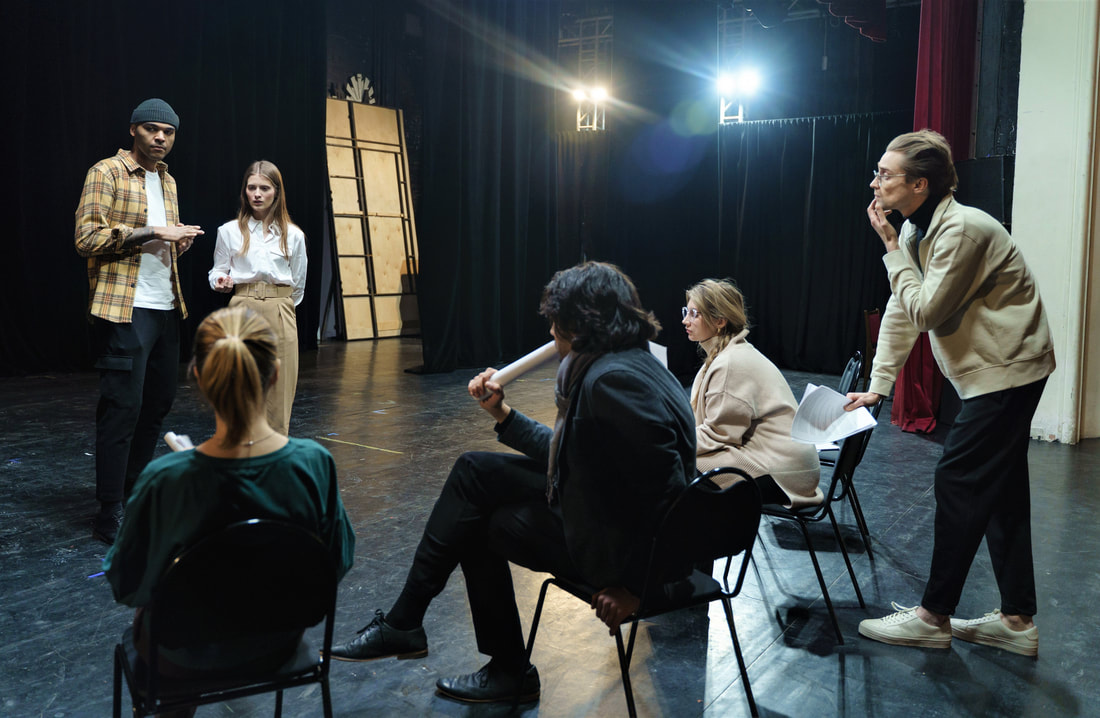 This is a thought experiment. I choose these words deliberately, because a spirit of experimentation lays at the heart of Gestalt practice. It’s about learning by doing rather than, say, learning by thinking or learning by talking. That marks it out from conventional ways of coaching, facilitation and action learning (AL). It’s about trying something new, seeing what surfaces into awareness as we do so, then noticing any shift in our stance in relation to an issue we’re grappling with. It can be revealing, radical and powerful. Picture this. During an AL bidding round, each person depicts physically the essence of an issue that they’d like to work on. This could be, say, by standing and posing or acting out a scenario; drawing or painting a picture for the group to see; sharing an object that, for them, carries particular resonance with the issue they’re facing; presenting a song, poem, or piece of prose that expresses the core of the issue and any feelings they hold around it. The group then moves onto choosing a presenter. The choice of presenter could be influenced by, say, the felt sense of imminence or urgency in what a person has depicted; the degree of complexity that emerged as they sought to depict different dimensions; the scope for experimentation with actual changes in what that person portrayed. This would feel different to an ordinary rational evaluation of the relative merits of different bids and, instead, would call for courageous sharing of empathy, intuitions and gut-instinct discernment. At the exploration stage, the peers in the set would pose questions and reflections physically, by doing something that invites reflection and response from the presenter. This could be, for instance, to stand with the presenter, mirror his or her pose and ask them what they notice; move with the person to physical places where they can view their picture from a range of different angles; invite the person to act out any metaphors they had used in a song or poem then to see what emerges. Moving between exploration and action stages, the set would invite the presenter to try things imaginatively that could stretch the scenario and themselves in relation to it. This could involve, for instance, inviting the presenter to experiment with radically different poses to find one that best represents the stance they want to take; making drastic changes to the picture and noticing how that feels; reciting the song or poem using opposite metaphors to those they had used originally. This challenge phase of the Gestalt process is sometimes described as co-creating a ‘safe emergency’ with the presenter. It allows him or her to experiment with and experience, say, moving between extremes, or to very different places (physically; psychologically; systemically; emotionally) to where they might naturally prefer or default to. It enables them to push their own boundaries; to speak what may ordinarily feel unspeakable for them, to do what may normally feel un-doable for them. The final action stage would involve inviting the presenter to depict physically, say, their aspiration in relation to the issue they have presented; the physical stance that best represents that aspiration for them; any obstacles or enablers that they could envisage on route – using physical objects in the room (e.g. chairs) to represent them – then physically navigating through them; or physically to take what they choose as their next steps, adopting the posture or stance they will take as they do so. What have been your experiences of using Gestalt in Action Learning? I’d love to hear from you! [See also: Toys; Crab to dolphin; Let's get physical]  ‘To lead real change, it’s not enough to think outside of the box. We need to think outside of the building.’ (Rosabeth Moss Kanter) Picture this. I’m in a coaching conversation with Anna, a client who feels stressed. She describes it as being like trapped inside a box, with no way out; where the box is her organisation, her job, the role she’s in now. The narrative she’s telling herself is that she has no possibility to escape from the debilitating pressure she’s experiencing. Her scope of authority to influence change is too constrained and she’s expected to deliver against targets that feel impossible. She feels totally helpless and hopeless. I acknowledge and empathise with how Anna is feeling, then ask if she’d be interested to explore potential options that could be available to her. At first, she pushes back, as if instinctively. ‘I don’t have any options – that is the problem’. I ask, inquisitively, to test the boundary a bit: ‘You could leave?’ ‘I can’t leave’, she replies, immediately and forcefully, ‘I have a mortgage to pay’. ‘So, the mortgage is part of the box?’, I ask. ‘Hmm. I guess it is’, she replies, more thoughtfully this time. ‘What if you weren’t to pay the mortgage?’, I ask. She looks bemused. ‘It would mean I’d lose the house, of course’, she snaps. ‘And, if you lost the house?’ ‘That would be terrible’, she replies, ‘It’s my dream home.’ ‘So, the dream home is, perhaps, part of the box?’ I ask. Anna goes quiet. After a while, she looks up and responds, ‘I don’t want to lose my home.’ ‘So: it’s as if, to keep your dream home, you feel that you have no option but to stay in your current job to pay your mortgage?’ ‘Yes.’ ‘Imagine now, for a moment, dismantling or breaking out of the box that you feel trapped in. If you were to imagine a spectrum of options, ranging from the status quo to what you might think of as a most extreme solution (the ‘nuclear option’), what might they be?’ Anna picks up a piece of paper and a pen and starts to write. ‘At the extreme end, I could sell the house and downsize to a cheaper house or location, then I could get try to get a less expensive mortgage, but I don’t want to do that.’ ‘At the other end, I could stay as I am and just accept that the frustration in my job is a price worth paying to keep the house that I love.’ ‘And..?’, I ask. ‘I guess I could apply for another job.’ ‘Say more?’ ‘Well, I could look at other jobs in my organisation.’ ‘Yet the organisation sounds like it may be part of the box too? What if you were to think outside of the box altogether?’ ‘True. I could look at job opportunities elsewhere, or even at a change of career that would feel more fun and fulfilling!’ ‘So, there are, perhaps, some options that could feel in tension for you? The house…or a career that could feel more fun and fulfilling? Which stands out as most important for you?’ ‘I hadn’t thought about it, but if I could find something I really love doing, I might just be willing to consider moving house to do it. Perhaps I’m allowing my attachment to the house to box me in.’ Suddenly, I see a lightbulb moment flash in her eyes. ‘Eeek…’ she says, ‘Perhaps the house is the box!’ Breakthrough. Anna has left the building. [See also: Boxes; Deconstructing the box; and Lateral instinct]  'Don't be still. One of the most common mistakes when change is upon us is to take enormous amounts to time to run analysis and come up with various routes to be followed. Sitting still in moving waters will only lead to a ship becoming adrift, with no indication of where it will end up or whether it will sink. If adjusting the course is needed, the leader should do it quickly and without hesitation.' (Raluca Cristescu)
The start of this new year has felt like a very rough ride for some people. I’ve been working alongside humanitarian disaster management experts in and from a wide range of countries, trying to make a difference for those who are poorest and most vulnerable in the world. In some places, wave after wave of devastating impacts have hit hard and fast, ranging from drought, crop failure and swarms of locusts to military conflict and deep civil unrest – all with the ongoing Covid-19 crisis overlaid on top. A close friend in the Philippines spent today with her children, praying earnestly and wrapping what few possessions they have in plastic bags in preparation for the roof of their fragile boarding house being torn off by an impending typhoon. Others I’ve been supporting have been grafting long hours, trying to help people and communities recover from the effects of war. The power fluctuates on and off, as does the wifi signal, making online communication difficult – yet I, we, they, persevere. My first direct experience of disaster response was some years ago during the Kosovo crisis. I travelled with a team across Spain, France, Italy and Albania to take emergency logistical supplies to refugee camps on the frontline border with Serbia. Our vehicles were fitted with spare tyres, satellite communications equipment and ballistic blankets in case we drove over land mines. I remember vividly the ‘No weapons on board’ symbols on our windows – signalling, I hoped, ‘Please don’t shoot us.’ We encountered challenge-after-challenge on route. At times, it felt as if everything was against us. As military helicopters flew overhead in impressive formation, we meanwhile were often stuck firmly on the ground, mired in red tape or the insidious effects of blatant corruption. It was a rapid learning experience for me, seeing how my seasoned disaster response colleagues handled this. It was my first exposure to adaptive leadership in a crisis too – out in the field, not inside an organisation. It went something like this: 1. Hold tightly to your goals and values but loosely to your plans. If you expect everything to go smoothly, you will get disheartened and frustrated. 2. Treat every roadblock as a new reality. It’s not the end of the road, it’s another challenge to navigate. 3. Think quickly and tactically. Lateral thinking will prove more useful than strategic planning. 4. When faced with an obstacle, take a decision and act. Don't stop, keep moving. 5. Pray – God can do more than you can do. This kind of activist-pragmatist outlook, behaviour and stance draws on and develops creativity, innovation, resourcefulness and resilience. It’s a way in which the poorest and most vulnerable people and communities learn to survive and thrive too. When a life situation is too painful, turbulent or dynamically-complex to understand, predict or control, a focus on the here-and-now can be the most meaningful choice. Even small steps can engender and evoke a real sense of agency, hope and change. My work now includes coaching, mentoring, facilitating and training of humanitarian field workers in action learning: a here-and-now, real-time methodology to stimulate adaptive leadership and learning in the midst of action. It’s an experimental pilot initiative with a global network of humanitarian non-governmental organisations (NGOs) and a team of action learning specialists. When have you developed or used adaptive leadership in a crisis? How did you do it? What difference did it make?  ‘It’s always best to pose a question, except when it isn’t.’ (Claire Pedrick) It reminds me of Ted Winship, a trade union activist I worked with as an apprentice. He often spoke like this: ‘It’s always the same, sometimes.’ It was a kind of word play that made people stop – and think. Or a teacher at school whose name, sadly, escapes me now: ‘If you have nothing to say, say it.’ It was some years before I finally worked out what she meant. I think too of Jesus. He often spoke in parables – stories, analogies, that left many of those who heard him feeling perplexed or bemused. Yet, why do it? In an era of endless soundbites, personal broadcasts, voices calling out loudly in all directions competing for air space, it’s hard to achieve cut-through. Even harder, perhaps, to achieve break-through; to have a meaningful influence or impact. We create and consume words like candy and in high volume, yet few provide the life-giving spiritual, mental and emotional sustenance we need to learn, develop and grow. How do you use language to evoke or provoke, reveal or inspire?  ‘Spontaneous counter-intuition.’ Those odd moments when, out of the blue, we find ourselves, suddenly and unexpectedly, acting radically-contrarily to our normal thinking patterns and behaviours – and yet with near-miraculous results. Have you ever experienced such a moment? What happened? What sense do you make of it? 'If you give children a problem, they may come up with a highly original solution, precisely because they don’t have the established route to it.’ (Edward de Bono) It was dark as I meandered through heavy, stationary traffic on my trail bike, trying not to be dazzled by headlights of on-coming cars. Suddenly, I noticed the strange shadowy figures of two men, one man attacking the other, punching him violently in the face against his car. Feeling like Bradley Cooper on NZT in Limitless, I pulled over fearlessly and strode towards them. I flipped up my visor, approached the aggressor, held out my arms in open gesture and asked, compassionately, if he was OK. He looked confused, stopped and skulked away. The other man, still propped against the side of the car with face covered in blood, thanked me profusely with breathy, gasping voice, ‘You saved my life.’ Now coming to my senses, as if waking up from sleep, I think I felt almost as surprised and relieved as he did. What on earth had just happened? How is it that I had acted so counter-intuitively in the moment and, in doing so, had ended the assault rather than escalated or become embroiled in it? I felt both stunned and amazed as I helped the man back into his car. It felt like a miracle. Edward De Bono coined the phrase, Lateral Thinking, to describe an approach to innovation and problem-solving that involves use of creative techniques that disrupt normal thinking patterns and stimulate fresh ideas. His ingenious methods helped to solve the human-psychological problem, ‘How can I think out of the box when I am the box?’ They help to break the frozen gaze, the ‘fixed Gestalt’, the mental webs of our own creation that become so entrapping for us (Gareth Morgan). And he made it possible to learn how to do it too. Yet how do we account for moments of instinct, of intuition, where we act, apparently laterally, without thinking, without conscious process of reasoning or decision-making? This looks and feels qualitatively different to lateral thinking, even if the results of it may appear so similar. How do we make sense of that sudden dream-like state, that doing the wildly unexpected thing that feels strange and unfamiliar, even to us? Is it something that we can learn, pray for, prepare for, especially in readiness for sudden crises? What do you think? Can I help you develop critical reflective practice? Get in touch! info@nick-wright.com  ‘Is that sufficiently unclear?’ (Richard Gold) I took part in a fascinating workshop with Richard Gold this week. Richard is a Lego Serious Play facilitator who uses Lego as a colourful, creative, engaging and experiential tool to raise awareness, evoke insight and generate ideas with individuals, teams and groups. The method involves touching, moving, doing – physically – rather than simply talking about. It is a fun, visceral method that plays with metaphor and imagination and invites experimentation and team collaboration. At each stage of the process, Richard offers minimal guidance, simple prompts, then asks in provocative spirit, ‘Is that sufficiently unclear?’ What a great question. It creates optimal space for serendipitous new experiments, insights and ideas to surface and evolve without being directive or prescriptive. It provides just-enough; inviting team participation, courage and co-creation. It reminds me of Henry Mintzberg’s ‘emergence’ – take a step forward and see what comes into view. So that got me thinking about leadership, OD, coaching and training. There are situations where directive and prescriptive interventions are entirely appropriate. Yet how often – perhaps in our desire to impress, be helpful or achieve the outcomes we hope for – do we exercise too much control over the person, task or process? How often, in doing so, do we limit the potential for personal/team initiative, ownership, discovery and innovation? Are you sufficiently un-clear? |
Nick WrightI'm a psychological coach, trainer and OD consultant. Curious to discover how can I help you? Get in touch! 
Like what you read? Simply enter your email address below to receive regular blog updates!


|
 RSS Feed