Imagine over 2 billion people. It’s enough to make me feel dizzy, roughly a third of the world’s total population, Christians all over the globe marking a very significant event this weekend. Easter. But what does Easter mean for Christians? Why is it so important? How is it different to a colourful, pagan, fertility festival marked by chocolate, rabbits and eggs?
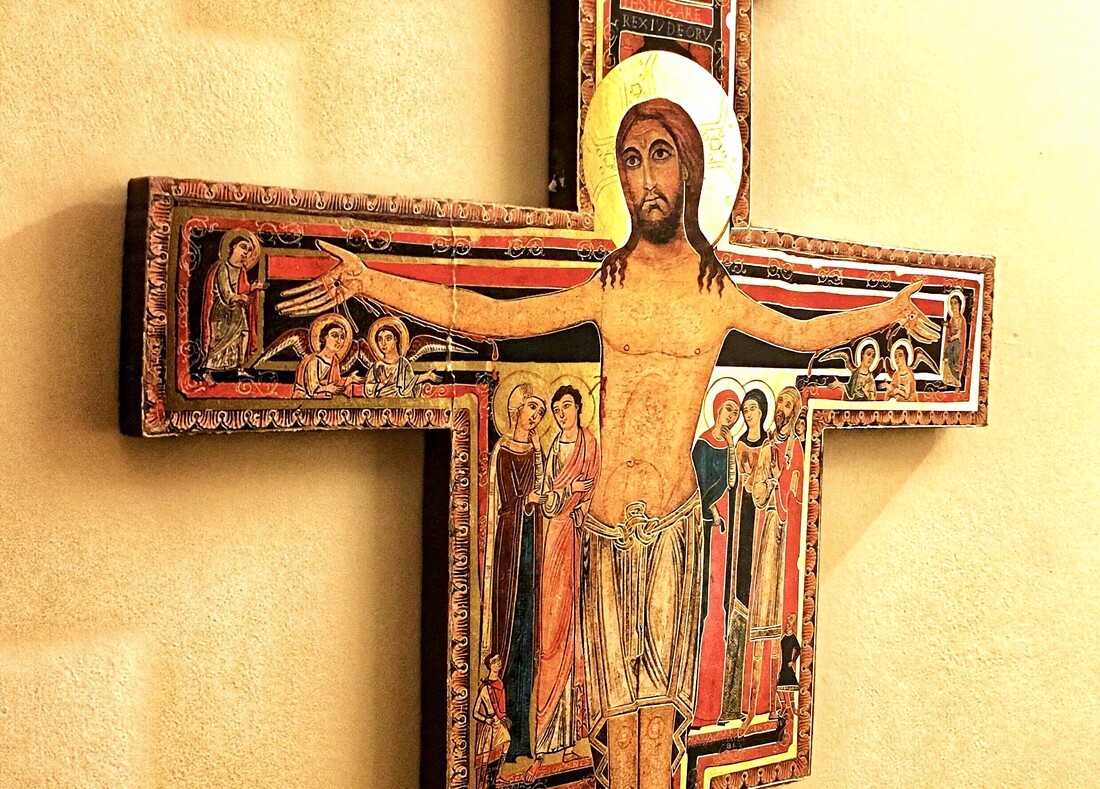
At the heart of the Christian Easter is a cross, a symbol used by Christians to highlight the centre-point of their faith. The cross is a reminder of Jesus Christ, the Son of God, crucified on a cross 2,000 years ago. It’s a shocking symbol, an instrument of Roman torture and agonising death. It draws our attention to a God-man-saviour, prepared to give his life for us.
That’s where it gets hard. What if the biblical account is true? Can I dare myself to believe it? What if Jesus really was the Son of God? Could he really love someone as messed up as me? I can only draw one conclusion. If this story is true, the cross cries out in the starkest possible terms that no matter who we are or what we have done, we really matter to God.
And there is more hope. Easter Sunday marks an equally remarkable event. This Jesus who died is raised by God. Miraculously, he is brought back to life and, what is more, promises us life over death by trusting in him. He offers us light, life and hope in the midst and beyond the dark deaths and despair we may face in life, psychological, emotional and physical.
So that’s where I place my faith. Not in my weak and inconsistent efforts to be a good person, a clever person, an interesting or adventurous person. I know what I’m really like inside. Amazingly, God is never disillusioned with me because he never had any illusions in the first place. I place my faith in Jesus. If the Bible is true, he truly deserves my life.
It stands around the corner from an authentic Thai restaurant in central London. On the face of it, it’s an elegant building. As you walk past, however, you realise with surprise that the frontage is a façade, an elaborate shield concealing a plain office building that lies behind it. It’s a striking metaphor, a symbol of sorts for an inauthentic life. It challenged me powerfully yet silently to consider the masks I wear, the images I project to disguise my real self.
Some years ago, John Powell published a popular, short self help book, ‘Why am I afraid to tell you who I am?’ He explored how we attempt to protect our fragile egos and avoid our fear rejection by acting out roles or playing games. These are defensive routines aimed at minimising social anxiety or negative evaluation. By putting on a front that we believe will impress others, we attempt to feel better about ourselves and to win others’ approval.
At one level, these strategies can prove successful in life and work. It’s one reason why we pay attention to our physical appearance, the way we behave and conduct ourselves in public, the way we present ourselves at job interviews etc. From our earliest childhood experiences, we learn what wins love and affirmation from others within our key relationships, social environments and culture. We learn how to play the game.
At another level, however, keeping up appearances can prove self-defeating. Over time we may feel alienated from ourselves, not sure how we really are, and alienated from others, not sure if we are really loved and accepted. We can feel lonely, frustrated and tired. It’s as if, paradoxically, the façades we create to develop and maintain relationships can have the opposite effect, preventing authentic and intimate contact with others.
This presents us with a dilemma, an anxiety-provoking risk. What if I remove the mask, tell you what I’m really thinking, show you how I’m really feeling? Would you love and accept me for who I am or would you look at me with disappointment in your eyes? Will making myself vulnerable release you to be vulnerable too? Can we find a new way of connecting that feels more real, more authentic, less defended, less like a façade?
It can feel like a breathtaking step. The possibility feels exciting and yet the potential feels daunting. I’m reminded of Jesus’ call in the gospels: ‘remove the mask and come into the light’. There is further New Testament teaching too: ‘perfect love casts out fear’. If God can love and accept me as I am, perhaps I can learn to love and accept myself and to love and accept others too. Perhaps that’s where it starts, feeling truly safe with God.
So therein lies the challenge. As a leader and a coach, am I willing to make myself vulnerable so that others can be vulnerable too? Can I demonstrate unconditional love with such honesty that others feel safe to remove their masks, to take down their façades? Can I find new ways to relate to others with an increasing sense of trust and authenticity, creating ever-deeper levels of contact? It’s certainly a goal worth praying and striving for.
I met with a group of Christian bikers yesterday who were discussing the Paris to Dakar rally. During the course of the conversation, the group leader spoke about the incredible teamwork and logistics involved in achieving success in such a gruelling event. He compared it by analogy to supporting each other as friends and fellow bikers on an exciting yet demanding journey of faith. He mentioned how we sometimes talk about the ideal team as a ‘well-oiled machine’. It was certainly a metaphor that appealed to the group. He went on, however, to challenge the metaphor. ‘A team isn’t a machine. It’s people. People like us. People like you and me. People who are different to each other, each with their own personality, talents – and quirky habits.’
He went on. ‘It’s that kind of team that I want to be part of. A team of friends who care deeply about each other, look out for each other, support each other, laugh together, cry together, pull together. A machine does none of those things. It’s cold, efficient, impersonal, inhuman. The machine metaphor is all about performance. The team I’m talking about is all about relationships.’ One bloke piped up with a playful glint in his eye. ‘This group is nothing like a well-oiled machine. It’s more like a buckled wheel – and I love it!’ As I looked around the room at these leather clad men, each with his own mixed life story of brokenness and success, I could see what he meant. There’s something about this team that's intensely human, personal and real.
I reflected more as I rode home. I thought back to teambuilding events I’ve been involved with, team coaching experiences, team models and technical scientific psychometrics. This man wasn’t simply advocating a different team model to the norm, a different team focus or approach. He was advocating a radically different existential–spiritual paradigm to that we find in many Western organisations today. He was challenging an over-emphasis on performance and efficiency that loses sight of humanity and meaning. I was taken back to a conversation with an African colleague who once commented, ‘I know Western organisations are preoccupied with targets and metrics. Our invitation, however, is to meet with us as people and to walk together.’
Is this hopelessly naïve, idealistic and unrealistic? What about all the pressures organisations face in increasingly competitive markets? What about increasing demands from boards, employees and shareholders for greater accountability, productivity and profits? What about organisational cultures that foster internal competition too? I agree, it’s a real challenge. It calls for visionary, courageous leadership, a radical step back to consider deep questions of identity, meaning and purpose at organisational and wider stakeholder levels. It begs profound questions, e.g.‘What is influencing our beliefs about what is most important to us?’ ‘What is driving our behaviour?’, ‘How can we be more human?’, ‘What legacy do we want to leave in the world?’
I’ve had the privilege of working with some leadership teams that have taken this challenge seriously. Admittedly, it felt counter-intuitive at the time, especially at first. How to build in a more explicit spiritual-humanising dimension to the organisation’s thinking, practice and culture in the midst of intense organisational busyness, pressures and deadlines? Wouldn’t it take more time than was available, slow things down? I could feel the understandable tension alongside the aspiration. One team decided to bite the bullet. Its 2hr meetings had constantly packed agendas. It struggled to work through everything and the pressure felt relentless. Some felt tired and wondered in conversations offline about their team’s sustainability and their own ability to cope.
We discussed how it would feel to check in with each other and with God at the start of each meeting - and they were open to experiment. We decided to allow 20 mins of each 2 hour meeting so that people could arrive and breathe before diving into business. As they settled in, they shared stories of how they were feeling, what was happening in their worlds at the moment, what was preoccupying them. They practised active listening, being genuinely present to each other. Sometimes they prayed. At the end of the 20 mins, they felt more relaxed and focused with a stronger sense of team spirit. They used the next 5 minutes to revisit the agenda: ‘What now stands out as most important to us?’ ‘How shall we do this?’, ‘What do we need to do this well?’
The team commented after practising this for a few months on how it had transformed their relationships and meetings. Their times together felt more focused, inspiring, energising, open, honest, human, and productive. They achieved higher quality and faster results. They began to identify ways of working that served them well (e.g. speak up; hear well; challenge; support) and used bright green cards light-heartedly to signal and affirm when anyone in the team modelled those behaviours. When others joined them for their meetings, they explained their new team culture and invited them to join in too. The effect was electric. It modelled inspiring team values and effective ways of working that extended beyond the team into the wider organisation.
So, some questions for reflection. What difference do you, your team and organisation want to be and to make in the world? How far and how often do teams you are part of feel and act like a human place? What are your best and worst experiences of team? What made the biggest difference? What kind of person, team or organisation do you aspire to be and become? What kind of personal, team and organisational leadership will it call for to succeed? What will 'success' look and feel like for those involved and impacted by it? What values, practices and culture will others notice characterise your team? What place, if any, do God, spirituality and prayer take in your thinking and practice as a team? I would love to hear from you!
I spent this week with a Christian social worker friend in South Germany. At one point, we visited a project for older people who want to learn how to use new technologies. The project is led by a group of volunteers from a similar age group who act as trainers, mentors and advisers. This friend who manages the initiative entered the room, smiled and said hello to the group, introduced me then walked around the room, purposefully shaking hands and greeting every person individually with genuine warmth.
The thing that struck me most was his profoundly-felt presence in the room. He has an unusual talent for standing, moving and gazing in such a way that demonstrates he is really here and really now. It communicates a deep sense of being and being-with that extends beyond words. The act of shaking hands, of physical contact, felt more than a cultural ritual and created a profound sense of emotional and relational contact with the group. I felt spell bound by this person, this quiet charisma, this dynamic he evoked.
It’s a sharp contrast with an approach to leadership, coaching or training that relies purely on professional competence or expertise. It’s so easy to lose contact with ourselves, God and others in the midst of the business of the day. We can become so preoccupied with a task that we lose sight of what really matters at a deeper human-spiritual level. As I watched this friend and felt his presence, I was reminded of words from the Bible: if I’m clever, competent and successful but do not love, I am nothing. (my paraphrase)
So my challenge as I return to England is to reflect more on my presence; to have a clearer and more focused sense of my deepest beliefs and values; to take a more intentional and resolute stance in relation to others that demonstrates love, warmth, care and authenticity. I want to be more aware of when I behave in professional mode but lose sight of a person or group; when I allow myself to get so busy, so task-focused that I lose sight of my own and others’ humanity. In short, I want to be more like Jesus.
What’s your theory of change? What issues are you trying to address? What creates and sustains those issues? What kind of interventions and when are most likely to prove successful? What would success look and feel like, and for whom? What is your overall goal? These are some of the questions we looked at on a Theory of Change workshop I took part in yesterday. Theories of change are becoming increasingly commonplace in the third sector, paralleling e.g. strategy maps in other sectors. There are a number of reasons for this. Charities and NGOs are under increasing scrutiny from supporters and funders to demonstrate how their resources are being used to achieve optimal impact. This has created a whole industry in impact evaluation.
The third sector is maturing too. No longer driven into action by empathy or altruistic instinct alone, organisations in this sector have more experience, more evidence of what works and what doesn’t and more analysis and understanding of why. The issues have turned out to be more complex than some had originally imagined, making significant and sustained progress challenging. Against this backdrop, a theory of change can prove valuable. It aims to clarify goals and outcomes and to work back to activities and other factors that will enable the outcomes to be achieved. In articulating these things clearly and succinctly (often in simple graphic flowchart form), underlying assumptions and causal links can be surfaced, explained and tested.
At heart, a theory of change answers questions such as ‘What are we trying to achieve?’, ‘What is necessary for the goal to be achieved?’ and ‘What’s the rationale behind our intervention strategy?’ In doing so, it makes the organisation’s focus, operations and use of resources transparent, accountable and more open to challenge and improvement as new research and evidence emerges. I find myself particularly drawn to the critical-reflective aspects. For instance, one NGO I worked with conducted a fundamental strategy review starting with these same principles, asking questions such as, ‘Why are people poor?, ‘What causes and sustains poverty?’, ‘What interventions make the greatest difference?’, ‘What is our optimal contribution?’
One of the interesting challenges for a third sector organisation is whose voice is represented in framing and answering such questions, e.g. donors, beneficiaries, trustees, staff, volunteers. A charitable organisation I work with currently conducted a strategy review recently, inviting feedback from beneficiaries using surveys, focus groups etc. to find out what they struggle with and aspire to and what role they would want to see the organisation playing in helping them address or achieve these issues. The needs and aspirations that surfaced have been summarised as ‘I’ rather than ‘we’ or ‘they’ statements in clear and colloquial language, keeping the focus on what each individual as beneficiary wants to experience as a result of the organisation’s actions.
This is a sharp contrast with some experiences I’ve had in the past. In one instance, a third sector organisation I worked with set up a drop-in project providing advice and support for long-term unemployed people. The Local Authority provided funding using ‘number of people using the service’ as its key success criterion. Paradoxically, the more successful the service was in enabling local people to find employment, thereby reducing the number of people who needed to access the service, the more the service was deemed statistically by the Local Authority to be failing. A theory of change can help surface such outcomes and assumptions at an early stage, enabling more constructive dialogue and agreement between agencies and stakeholders.
I believe the potential for theory of change extends beyond third sector organisations aiming to articulate their vision, strategy, plans and reasons behind them. I’ve used similar methodologies to explore and articulate an organisation development strategy within a third sector organisation. We started by exploring a number of questions with diverse stakeholders and groups such as, ‘What kind of organisation are we trying to develop?’, ‘Where are we now?’, ‘Why are things as they are?’, ‘What drives or sustains how things are?’, ‘What matters most to people here?’, ‘Who or what influences change?’, ‘What would it take to achieve the changes?’ This enabled us to create a map showing goals, activities, assumptions and causal relationships.
The same principles can be applied at team and individual levels too, e.g. for leadership, coaching, mentoring, training and counselling purposes. It enables dialogue between different parties and keeps rationale and assumptions explicit. If assumptions are clear to all parties, they can be challenged and revised in light of different preferences, perspectives, realities and evidence. I’ve used adaptations of this approach with people and organisations where Christian beliefs have been held as important and integral, developing the model as a theology of change. A theology of change may surface and articulate e.g. God’s purpose, values, presence and activity in the world, the role of the Spirit and Christians, discerning a sense of ‘calling’.
In my experience, the language and methods of applying theory or change need to be adapted for different purposes and audiences. It represents a logical-rational paradigm that is likely to work well for some people and cultures but not so well for others. Using Honey & Mumford’s learning styles as one possible frame of reference, theory of change (as the name implies) may appeal most to people, teams or cultures with a theorist orientation. Reflectors may be attracted most by its emphasis on surfacing underlying assumptions, activists by the evidential dimensions and pragmatists by its focus on outcomes. Perhaps the key lies in using the principles it embodies flexibly and sensitively in the context of real human dialogue and relationship.
The first thing I notice is the random cluster of bikes parked outside the café ranging from Japanese street machines to British and American cruisers. I wander inside and get myself a hot mug of tea. There are no formal welcomes, only various bikers in black leathers and motorcycle gear sitting in small groups, talking earnestly or laughing as they chat together. The leader walks in. He has long hair, a wispy beard and piercing blue eyes. This man, Graham, has an unusual warmth in his smile as he glances around, beckoning informally to whoever is interested to join him in the room next door. We get up and slowly wander in across the cold hallway. The seats, like their occupants, are covered in black leather. It’s chilly inside and there’s a single oil-filled heater in the corner. The conversation starts easily, people speaking in relaxed tones as they talk about the ride in, things that have been happening at work in the past week, ordinary things, everyday things. There is no ecclesiastical language, no religious jargon, no speaking in stuffy tones. It feels natural, real. I wonder what’s going to happen next, curious about this earthy bunch of heaven’s angels. This was my first encounter with a Christian Motorcyclists’ Association (CMA) meeting, a loose organisation of ordinary blokes who share two passions: bikes and Jesus. One person talks about how much he struggles to get his head around anything to do with God at the moment, feels very messed up like everything is going wrong in his life. Others around the room nod and empathise. He looks reassured. Another talks excitedly about his return to faith after years in the drugs and clubs scene. He is energetic and animated as he speaks and his enthusiasm is infectious. Another looks thoughtful and talks about how, when he’s working on his bike, he gets totally focused on it. He goes on to comment how easy it is to get preoccupied with things, whether good or bad. The conversation, like the bikes outside, feels random but a strange flow emerges. The bloke next to me chips in, ‘If we focus on something long enough, act on it consistently enough, we become defined by it.’ The bloke next to him agrees and says ‘Yes, like anger. If we allow someone to anger us, they control us.’ Another says, ‘Yes, and if you are always angry, it becomes who you are.’ The room falls silent. One by one, these men start to share stories about when they’ve been angry, when someone has really wound them up, treated them unfairly, different things they’ve tried to deal with it. It gets quite heated at points and Graham chips in with Jesus’ teaching and example of forgiveness, how meaningful it is, how healing it can be. It felt unforced, timely, but I wonder how the others will react. They start mulling over this, how difficult it can be, what it feels like when they manage it even if only for a short time. You can tell these blokes want to get it right, want to follow Jesus’ example, and they’re instinctively determined not to gloss over realities. They close by praying out loud, whoever wants to, speaking on behalf of the group. ‘God, help us because we can’t do this stuff on our own.’ The meeting closes and we stroll back into the café. The whole thing has lasted just 30 mins. I feel immediately inspired and challenged by what I’ve just seen, heard, felt, being part of. I don’t own a bike (although I've owned 21 and crashed 19) but these guys accept me, a stranger. As we chat and laugh over bacon and egg, they are the same in the café as they were in the room. No facades, no pretence. They’re happy to get their hands dirty and their faith is very practical too, looking out for each other, providing pastoral care at biker events, running charitable activities, praying for people who need support. We exit the café, the bikes rumble off with a snarling roar…and I’m left with the distinct impression I’ve been in the presence of Jesus. ( www.bike.org.uk/cma)
I took part in an excellent mediation workshop this week run by Karen Bailey, a talented and experienced coach, mediator and trainer in this field ( http://www.karenbaileymediation.com/). I found it interesting to explore different models and approaches ranging from arbitration and advocacy through to non-directive facilitation. It resonated for me professionally because, as an OD practitioner, I’m often invited to coach others on conflict resolution, to do teambuilding where unresolved conflict is a factor affecting team morale and performance, or to act as a third party helping others (e.g. line managers and staff, or peers) to address and resolve stuck-ness or tensions between them. It also resonates for me spiritually because the notion of mediation is at the heart of my Christian beliefs. The biblical characterisation of Jesus Christ as mediator between God and humanity is the cornerstone of Christian theology, a role that Christians too are called to emulate and follow as peace-builders in the world. The model we explored and practised emphasised the importance of creating a semi-structured space for parties to listen to each other. If they can genuinely hear each other, there is scope for establishing empathy and reaching shared solutions. This involves the willingness of all parties to engage in open, direct and…potentially scary…dialogue. The mediator speaks to this fear dynamic explicitly: ‘This is going to feel very uncomfortable, but we’re here because we believe the outcome will be worth it.’If the mediator and participants can learn to manage their own anxiety by facing it head on, they may also feel able to lower their defences and hear each other. We looked at four conditions that enable this type of mediation to be successful: the mediator is impartial; the mediation is confidential; participation is voluntary; outcomes are self-determined. These condidtions provide a basis for establishing clarity and for contracting with oneself, participants and sponsors beforehand. Karen explains why these same conditions can sometimes make it difficult for internal HR (or OD) practitioners to fulfil this role within their own organisation or business partnering arena effectively. (For further comment on this issue, see: http://www.karenbaileymediation.com/transforming-hr-practitioners-into-mediators/). We also looked at four aspects of participant experience and perspective that provide a content-orientated focus for the mediation: each participant’s Story; each participant’s felt Impacts; each participant’s Needs; each participant’s Goals (making the acronym SING). The mediator meets with each participant to tease out these aspects beforehand. The participant’s story is his or her own subjective experience of the situation; impacts are what he/she is feeling emotionally; needs are unfulfilled desires or challenged values; goals are the outcomes each person hopes for. ‘What’s going on for me’, ‘How this is impacting me’ and ‘Why this is important to me’. At the start of the session with all parties in the room, the mediator reiterates the process and invites the participants to (a) be honest and direct with each other and (b) listen and show respect to each other. The mediator may invite each party to make an opening statement and then allow the conversation to free-flow. The tricky part I found as mediator-in-practice was when to intervene and not to intervene, how to intervene in such a way that facilitates rather than interferes with the process, how to manage my own anxieties if ferocious conflict emerges, if one party appears bullied or if the conflict became directed at me. Karen offered some useful ideas…simple in principle, harder to do in practice! The mediator can summarise, reflect back…’This is what I’m hearing…’, ‘Sounds like…’, enabling the participants to feel heard before moving on. The mediator can call for a break, allowing mediator and participants to step back, take time out if they need to cool down or reflect before re-engaging. The mediator can co-facilitate with another mediator, creating the benefit of two perspectives, insights and interventions, especially valuable if one of the mediators feels hooked, emotionally destabilised or disorientated by something in the conversation and needs to detach in order to re-engage. The real challenge, opportunity and skill lies in enabling the participants to establish and maintain high quality contact with each other, even if that contact feels loaded with intense emotion. It’s a process that involves faith, faith that if the participants will find a way to hear and connect with each other, that they may feel empathy and will move towards finding their own solutions. It also demands that the mediator be fully present in the room, fully in role and fully in contact with participants. The session ends with participants discussing and agreeing their own way forward. This kind of mediation clearly demands patience and courage but the benefits can be transformative.
I had strange dreams about mirrors and reflections last night and woke early in the darkness. I lay there for a while, semi-conscious, daydreaming about the brightness of the moon and how it reflects the light of the sun. I prayed silently, instinctively, ‘Just as the moon reflects the light of the sun, may my life reflect the light of God’. Then I woke up.
I do think there’s something profound about mirrors and reflection as psychological, cultural and spiritual phenomena. The recent fantasy film, Snow White and the Huntsman created a vivid portrayal of a tormented queen returning repeatedly to seek reassurance in the mirror of legend: ‘Mirror, mirror on the wall, who is the fairest of them all?’
The queen’s sense of self, security and value were based on the response from the mirror. It’s as if she didn’t really know who she was, how she was, without reference to its external perspective. According to psychodynamic and social psychological theories, our sense of self is affected by the responses we evoke and encounter in others.
Take, for instance, a young child who gazes into its mother’s face. If it sees consistent expressions of warmth, attentiveness, affection and happiness, it may well develop the sense that ‘I am loved’ and, thereby, ‘I am loveable.’ If on the other hand the child consistently sees looks of disapproval, it may develop a negative sense of self.
Psychodynamic theorists (e.g. Winnicott) call this process ‘mirroring’.Just as a person knows what they look like by glancing in a mirror, a child sees something of itself, learns something about itself, its relationships and its place in the world, by observing what is mirrored in the face of others. It’s a process that continues throughout our lives.
This phenomenon has deep existential implications. Corinne Taylor in her paper, You are the fairest of them all, comments on what may happen if a mother lacks connection with the child and fails to offer mirroring: ‘Perhaps a mother with a rigid face gives the baby the sense of never having being at all.’* Its very existence may feel negated.
Richard Rohr in his book, The Naked Now draws spiritual parallels, inviting us to consider what we see in God’s face, his gaze, as we gaze at him in prayer. It’s as if God is the ultimate, absolute parent figure in whose face we are able to gain a true sense of who we actually are. A distorted image of God will create a distorted image of self.
Projection is a related psychological process whereby we project aspects of ourselves (often aspects we feel uncomfortable with) onto other people or even onto God. I may be aware of and focus on characteristics of others that I’m not aware of or deny in myself, even though others may recognise them as typical of me.
If I grow in awareness of my projections, I can grow in awareness of myself by noticing what I notice in others. It’s another form of mirroring. As a leader and coach, I can draw important lessons too: what do others see in my face; do my responses help others develop a truer and more-loved sense of self; do I reflect the light of God?
(*http://www.hertspsychotherapy.co.uk/%e2%80%98you-are-the-fairest-of-them-all%e2%80%99-an-exploration-of-the-concept-of-mirroring/)
Christmas time. A special time to enjoy family, friends and festivities. For many of us, it’s a time off work, chance to relax, eat, drink and party. There is, however, a deeper meaning to the event, a meaning embedded in its very name: Christ-mas. For Christians, it represents a celebration of a unique and critical moment in history, the birth of Jesus Christ. This distant event has important implications for my work in leadership, OD, coaching and training.
The idea of God as a human child should shock, confuse and amaze us. After all, if God exists and if he really is everything the Bible says he is, e.g. all powerful, all knowing, an invisible being, it makes no sense to imagine all those qualities in a vulnerable, dependent, human baby. The arrival of Jesus, the transcendent become immanent, is a profoundly paradoxical event. Little wonder so many people today find it difficult to imagine, understand or believe.
I find it stimulating and humbling to reflect on this. It calls me to ask serious questions of myself, my life and my work. Whatever I’m doing, whatever role I’m playing, my work is essentially about people, developing people, releasing potential, building a better organisation, a better world. So I will share five short thoughts and meditations this Christmas kairos evokes for me. Please share your reflections and responses with me too. I’m keen to hear.
1. God as human. The appearance of God in human form (Gestalt) reminds me of the notion of contact in Gestalt psychology, a deep sense of presence and connection with people. It’s about intimacy, empathy, touch, being-with in the here and now. In my work, I sometimes become so focused on the task that I can lose touch with myself, with others, with God. Incarnation is about coming close. How can I develop and sustain a better quality of contact?
2. God as child. The Christ child reveals God at his most vulnerable, a willingness to take risks and to depend on others. It reminds me of notions of attachment in psychodynamic psychology. It sounds inconceivable to imagine God placing his life, his wellbeing, in human hands. Yet it challenges notions of arrogant, egotistical, macho leadership. It models humility, trust, a working with others to achieve a purpose. How can I become more humble and inclusive?
3. God as love. In becoming human, God enters human experience. Jesus’ loving, empathetic way of relating to people reminds me of notions of relationship, positive regard and authenticity in humanistic and person-centred psychology. He balances ‘grace’ with ‘truth’ in a way that I find very difficult. He demonstrates altruistic self-sacrifice, critical friendship and tough love. How can I be better and more consistent at putting others’ best interests first?
4. God as truth. The arrival of God in human history in such a dramatic, physical way challenges previous notions of God and of humanity. God challenges all presuppositions, cultural perspectives and traditions. This reminds me of addressing limiting beliefs in cognitive psychology, fixed Gestalts in Gestalt psychology and personal-social constructs in social constructionism. How can I work with others to explore and create fresh possibilities, fresh paradigms?
5. God as saviour. The Bible depicts Jesus Christ entering the world to save a humanity that is lost. This notion of lost-ness reminds me of ‘angst’ in existential and psychodynamic psychology, a deep feeling of alienation from oneself and others and from any sense of ultimate meaning and purpose. It’s as if Jesus resolves our alienation from God and the world to bring new hope. How can I ensure my work brings fresh meaning and hope to others?
I wish you a merry Christmas and a very happy new year!
Critical reflexivity…hmm…what’s that? Sounds complicated. I was re-reading one of my favourite books, An Invitation to Social Construction (2009) by Kenneth Gergen this morning which introduces this concept with the following explanation:
‘Critical reflectivity is the attempt to place one’s premises into question, to suspend the ‘obvious’, to listen to alternative framings of reality and to grapple with the comparative outcomes of multiple standpoints…this means an unrelenting concern with the blinding potential of the ‘taken for granted’…we must be prepared to doubt everything we have accepted as real, true, right, necessary or essential’.
I find this interesting, stimulating and exciting. It’s about journeying into not-knowing, entertaining the possibility that there could be very different ways of perceiving, framing and experiencing issues or phenomena. It’s about a radical openness to fresh possibilities, new horizons, hitherto unimaginable ideas. It’s a recognition that all assumptions and preconceptions about reality could be limiting or flawed.
I’ve found this critical reflexivity principle invaluable in my coaching and OD practice. How often people and organisations get stuck, trapped, by fixed ways of seeing and approaching things. The same cultural influences that provide stability can blind us to alternative possibilities. The gift of the coach or consultant is to loosen the ground, release energy and insight, create fresh options for being and action.
It certainly resonates with my reading of the gospels. Jesus Christ had a way of confronting the worldviews, traditions and apparent ‘common sense’ outlook of those he encountered in such a way that often evoked confusion, anger or frustration. It’s as if he could perceive things others couldn’t see. He had a way of reframing things that it left people feeling disorientated. He operated in a very different paradigm.
This is one point at which spirituality meets philosophy and psychology. I too get easily trapped in my own constructs so I pray to God to open my eyes, to reveal new insights and unrecognised opportunities. Jesus’ words speak to me with renewed impact. He came ‘to proclaim freedom for prisoners, recovery of sight for the blind, to set captives free.’ It’s about fresh awareness, deep liberation and a renewed life.
|