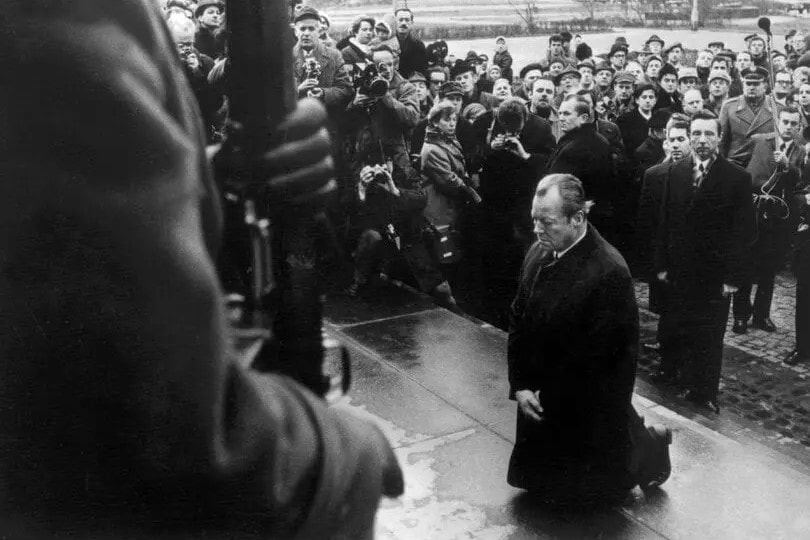
 ‘To the victims of violence and betrayal, in the hope of an enduring peace.’ (Willy Brandt) Angelika gave me a gift this year of a shiny German 2 Euro coin. It was minted in 2020 to commemorate 50 years since West German Chancellor Willy Brand’s legendary ‘Kniefall’. I had heard of Willy Brandt but, I must confess, not the act that has, since, gripped my imagination. The German word Kniefall means, quite literally, to fall to one’s knees. I’m especially indebted to Valentin Rauer’s exceptional social-psychological study, Symbols in Action (2009), of what took place in that extraordinary moment in world history. I’m curious about what it meant and what made it so powerful. Brandt visited Warsaw in Poland, 25 years since the end of World War 2, on a mission to seek post-war reconciliation. Poland, including its Jewish population, had suffered horrific genocidal brutality at the hands of the Nazis. At the Monument to the Heroes of the Jewish Ghetto Uprising (against their Nazi oppressors in 1943), with a crowd of media reporters watching, Brandt suddenly and unexpectedly fell to his knees. He stayed there, in silence, as those around him looked on in amazement. It was an astonishing example of an action speaking far louder than words. At a political level Brandt, as Chancellor, represented West Germany. At a personal level, during the war, Brandt had been an anti-Nazi activist. The imagery of Brandt’s Kniefall, as an act of penitent humility that acknowledges guilt and seeks ‘forgiveness for an unforgivable past’ (Rauch), resonated deeply in a prevailing Christian culture. The symbolism of ‘the innocent (who) takes up the burden of the collective’s sin, thus redeeming the nation’ (Rauer) reflected Jesus Christ’s death on the cross. Brandt was in the square from which Jews were deported to concentration camps. For me, the most striking and moving dimension of this event was Brandt’s own reflection on the spontaneity and authenticity of his act: ‘Faced with the abyss of German history and the burden of the millions who had been murdered, I did what people do when words fail us.’ It paints the picture of a human being, beyond the public trappings of a politician, who allowed himself to feel empathy and brokenness, to take undefended responsibility and to reach out in peace. It transformed the trajectory of Cold War politics then. How desperately we need leaders like that now.
14 Comments
 ‘The international arms trade is in direct opposition to efforts to protect and pursue the health of our world and its inhabitants.’ (MedAct) When Jesus Christ was born, if he had been given the projected world armaments spend for this year alone – I have to sit down as I write this: he could have spent US$ 2,708,578 every… single… day... from then until now. And, whilst on the topic of Jesus, a good friend has a satirical sticker across the rear windscreen of her campervan that reads, ‘Who would Jesus bomb?’ The simple answer is, ‘Nobody’. He was far too concerned with bringing good news to the poor, vulnerable and oppressed. Bottom line: weapons didn’t feature on his bottom line. Yet here today we see world leaders striding confidently onto stages, adorned with flags and symbols, making elegant speeches and pointing accusing fingers at one another across starkly-divided world maps. Everyone is firmly committed to the, ‘I’m OK, You’re Not OK’ creed and absolutely convinced by the rightness of their own cause. The platform rhetoric is powerful, existential, and ramps up the ante. It’s a dangerous zero-sum, do-or-die game in which we could all – quite literally – obliterate the world in a quest to, allegedly, save the world. Meanwhile, I see children in the Philippines this week who live in dire poverty, sleeping in rags on hard ground. There are countless millions across the world living like this, with barely enough to survive let alone thrive. Scraps of food and no access to safe water, sanitation, healthcare or education. US$ 2,708,578. So, Jesus again – ‘Reach out to your enemies.’ We could try this: ‘We’ve all made a real mess of this. We’re partly to blame and we’re sorry for the part we played in how we got here. We want to work with you to co-create a very different future.' Everything is at stake.  'The one thing we owe absolutely to God is never to be afraid of anything.' (Charles de Foucauld) I once heard a psychotherapist say that she always pays special attention to the final words a client says, often as they are touching the door handle and about to leave. It’s where a client may reveal the core of an issue, perhaps because they feel safe to do so now that they are leaving, or sometimes because a new insight emerges just as they approach the boundary that the doorway represents. A close friend’s father had fought with the German Wehrmacht on the Eastern front in World War 2. He was a young man at the time and, along with his peers, had taken part in terrible atrocities. As he approached that final boundary, the end of his life, he felt deep despair over what he had done and a terror of meeting God. I met with him, an Engländer. We hugged and cried. Now he could die in peace. This feels very poignant to me as we approach Easter. Jesus Christ’s final words, ‘It is finished’, hold special meaning for me. I spoke with an EMDR therapist recently about a painful boundary, a traumatic experience, that I went through as a teenager. It was a brutal ending. My life was finished. Yet Jesus, Saviour, found me there. It is finished. That life was finished. Resurrection: a new life began.  ‘I could hear an inner voice saying to me, 'Stand up for righteousness. Stand up for justice. Stand up for truth.’ (Martin Luther King: shot dead for preaching love, equality and peace). I feel sick. A 16 year old girl. Deemed: enemy of the state. Beaten to bloody death by insecure security forces, the brutal fisted hands and booted feet of a repressed, repressive regime. Her crime – now read this carefully because this is serious: she…burned…a…headscarf. Death penalty. No mercy from merciless leaders who claim so cynically to represent the merciful. Nika Shakarami. Remember the name. She shines as a bright emblem of resistance and hope, alongside Malala Yousafzai – the 15 year old girl shot in the head for daring, so shockingly, to say: it’s OK for girls to go to school. Remember too: Sophie Scholl, the 21 year old young woman, murdered violently by violent psychopaths for advocating non-violence in another era. God help us. Please pray.  'To err is human. To blame it on someone else shows great management potential.' That made me laugh! It’s a fun variation of Hubert H. Humprey’s, ‘To err is human. To blame someone else is politics.’ But wow – how easy it is to deflect and project our own faults and failures outwards onto others. We see it happen all over the place, from interpersonal relationships to international relations. It’s a way of defending ourselves; of trying to avoid or escape the costs of responsibility; of promoting ourselves; of appearing innocent or superior. It’s about helping us to feel good about ourselves and-or wanting someone else to feel good about us. It's quite tricky if we don’t know we’re doing it – and it can lead to potential high-risk consequences. ‘Self-deception is like this. It blinds us to the true causes of problems, and once we’re blind, all the solutions we can think of will actually make matters worse.’ (Arbinger Institute: Leadership and Self-Deception, 2000). This poses a difficult question: how to deal with our blindness if we don’t know we’re blind? And what if, if we’re honest – for whatever reason – we don’t want to know? An old adage goes: ‘There are none so blind as those that won’t see.’ Ignorance is bliss? I’ll start with the last question first. If I’m working with a person in coaching or a group in action learning and I sense resistance in this area, I won’t push too hard. It could, for instance, trigger repressed trauma or suppressed anxiety. Instead, I may pose an invitation, e.g. ‘Is this something you would find useful to explore further? What, for you, would be the potential benefits of exploring this, or the potential costs of not exploring it? If you were to explore this, what support or challenge would you need from yourself, me and-or others?’ It’s their call, their choice. Next to the first question. This touches on a field known as critical reflexivity. It’s like holding up a mirror to ourselves rather than fixing our gaze elsewhere or onto others. We can think of it as something like this: ‘What within me – e.g. in my own past, culture or world – is influencing what I’m thinking, feeling and doing now?’ This could include, for instance, our beliefs, values, hopes, fears and expectations. It could also include hidden vested interests; that is, things we want to protect or preserve and-or to acquire or achieve. Such influences act as subconscious filters. In coaching and action learning, I work with people and groups to help them learn to pose searching questions to themselves in a spirit of open curiosity and discovery, e.g. ‘Who or what is holding my attention in this relationship or situation? How am I feeling? Who or what am I not-noticing? What assumptions am I making? How is my past influencing my present? Who or what matters most to me now? How might I be evoking this response in the other party? What am I willing to take responsibility for? What do I want or need? What am I willing to stop, start, change or compromise?’ The outcomes and benefits of this approach can be truly transformational. It calls for humility, courage, authenticity and a willingness to exercise personal leadership and agency, yet can open up all kinds of fresh possibilities – and hope. Imagine, for instance, to approach an adversary, prayerfully, in the midst of conflict: 'We are in such a mess. I'm sorry...and, as I look at how we got here, I could have handled my part in this better...' It’s a stark contrast to avoidance, accusation and finger-pointing. What a possibility to co-create a different relationship – and a different future. (See also: Spots; Art of Deception; Stealth) When teams are under pressure, e.g. dealing with critical issues, sensitive topics or working to tight deadlines, tensions can emerge that lead to conversations getting stuck. Stuck-ness between two or more people most commonly occurs when at least one party’s underlying needs are not being met, or a goal that is important to them feels blocked.
The most obvious signs or stuck-ness are conversations that feel deadlocked, ping-pong back and forth without making progress or go round and round in circles. Both parties may state and restate their views or positions, wishing the other would really hear. If unresolved, responses may include anger/frustration (fight) or disengagement/withdrawal (flight). If such situations occur, a simple four step process can make a positive difference, releasing the stuck-ness to move things forward. It can feel hard to do in practice, however, if caught up in the drama and the tense feelings that ensue! I’ve found that jotting down questions as an aide memoire can help, especially if stuck-ness is a repeating pattern. 1. Observation. (‘What’s going on?’). This stage involves metaphorically (or literally) stepping back from the interaction to notice and comment non-judgementally on what’s happening. E.g. ‘We’re both stating our positions but seem a bit stuck’. ‘We seem to be talking at cross purposes.’ 2. Awareness. (‘What’s going on for me?’). This stage involves tuning into my own experience, owning and articulating it, without projecting onto the other person. E.g. ‘I feel frustrated’. ‘I’m starting to feel defensive.’ ‘I’m struggling to understand where you are coming from.’ ‘I’m feeling unheard.’ 3. Inquiry. (‘What’s going on for you?’). This stage involves inquiring of the other person in an open spirit, with a genuine, empathetic, desire to hear. E.g. ‘How are you feeling?’ ‘What are you wanting that you are not receiving?’ ‘What’s important to you in this?’ ‘What do you want me to hear?’ 4. Action. ('What will move us forward?’) This stage involves making requests or suggestions that will help move the conversation forward together. E.g. ‘This is where I would like to get to…’ ‘It would help me if you would be willing to…’. ‘What do you need from me?’ ‘How about if we try…’ Shifting the focus of a conversation from content to dynamics in this way can create opportunity to surface different felt priorities, perspectives or experiences that otherwise remain hidden. It can allow a breathing space, an opportunity to re-establish contact with each other. It can build understanding, develop trust and accelerate the process of achieving results. It’s Christmas Day and I could have better used the title Christmas mess-edge for this short piece. The story of Jesus Christ isn’t just a sweet and sentimental account of a baby boy born in Bethlehem 2000+ years ago. If it’s true, it’s about God entering the very real messiness of our lives and world and offering the potential to transform them into something completely new. Something beyond our wildest dreams, hopes or expectations. Something that stretches and transcends the boundaries of all human existence and experience.
I’ve known something about this notion of stretching boundaries over this past year, about extending the edges of my own experience. I bought a new bike in the spring, challenged myself to cycle over 1000 miles in 6 months and over 50 miles in a single ride. I had never done anything like that before and yet I did it. I also challenged myself to swim 1 mile 3 times in the same week. And I did it. It felt like I had crossed over an important physical and psychological line, achieving things that had previously felt impossible for me. I wrote and had published my first article with the British Association for Counselling and Psychology (BACP). I’d written lots of articles for different publications before but this felt like the next step up in a professional field that sits close to my heart. The editor of Coaching Today invited me to write on spirituality and I jumped at the chance. To top it off, I did my first ever series of radio interviews on spirituality too. It was a great opportunity and a novel experience so sit in a recording studio and to share my beliefs openly on air. And if that was the end of the story, there would be no need for a Jesus, at least for me. But it’s far from the end. I’ve struggled and failed on so many fronts. Sometimes, I haven’t even struggled when I have known I should. I’ve known deeply and personally what Francis Spufford aptly calls the universal ‘human propensity to f* things up’ (Unapologetic, 2013). At times, I’ve failed in relationships, made mistakes at work, fallen short of my own standards, spoken when I should have kept quiet and kept quiet when I should have spoken. What’s more, one of my closest friends has fought courageously with terminal illness. I’ve felt hopeful and helpless, trying to offer support where I could yet knowing I can’t make it OK. I’ve yearned to take the anxiety away but known that I can’t. I’ve watched Syria in the news, the damage that human beings are able to inflict on each others’ lives, on whole countries and regions. I’ve felt impotent and confused. Not all the time, but enough to know that redeeming the world is something I can take part in yet, ultimately, lies well beyond me. And so as I reflect on Christmas, I know what it is to be an aspiring yet fragile human being. I’ve felt exciting moments on the edge of success and have known what it is to screw up and need forgiveness. I have felt the amazing love of others, often undeserved yet tangible all the same. At that first nativity, I believe God himself entered the messy complexity of our lives and world with the most profound message of love and hope possible. Not just in words but in a life well-lived and a promise of presence and eternal life. Merry Christ-mas! My boss had been reading John Ortberg’s ‘Everybody’s Normal Till You Get to Know Them’ and it was time for us to plan our annual leadership team retreat. Looking for a theme title, he suggested half-jokingly, ‘How about ‘Everybody’s Weird’?’ I laughed at first but then thought for a moment…what a great concept and idea. It felt inspired. How to blow away any sense of normality and conformity and to meet each other afresh as we really are. Our creativity lies in our unique weirdness and what a great way to explore our individual quirkyness and its potential for the team and organisation.
Every group, every team, develops its own normative behaviours. Some even prescribe them by developing explicit competency and behavioural frameworks. It provides a sense of identity, stability and predictability. It can also improve focus and how people work together by establishing a set of ground rules, how we can be at our best. The flip side of all of this is that a team can begin to feel too homogeneous, too bland. It can lose its creative spark, its innovative spirit. The challenge was how to rediscover our differences, our wonderful, exciting, diversity in all its weird complexity. We invited people to bring objects that represented something significant in their personal lives and to share their stories. We invited people to use psychometrics to explore their preferences to shared them in the group. We invited them to challenge the psychometric frames, not to allow themselves to be too categorised. We invited people to challenge stereotypes, to break the moulds they felt squeezed or squeezed themselves into, to look intently for what they didn’t normally notice in themselves and each other, to allow themselves to be surprised and inspired by what they discovered. It felt like an energetic release. People laughed more, some cried more, others prayed deeply together. The burden of leadership felt lighter as people connected and bonded in a new way. It felt easier to challenge and to encourage. By relaxing into each other and themselves, people became more vibrant, more colourful, less stressed. They saw fresh possibilities that lay hidden from sight before. They discovered more things they liked about each other, fresh points of common passion, interest and concern. They built new friendships that eased their ways of working. It felt more like team. What space do you and your organisation allow for weirdness? Do you actively seek, nurture and reward differences? Do your leadership style and culture bring out and celebrate individuals’ strange idiosyncracies, each person’s unique God-given gifts, talents and potential? Have you had experiences where a capacity for weirdness has enhanced your team or organisation’s creativity and innovation? Do you risk inadvertently squeezing out the best of weirdness by policies and practices that drive towards uniformity? Could a bit more weirdness be more inspiring and effective – and fun?! :) A good friend in the police service once commented how he would arrive at work each day, put on his uniform and spend the rest of the day ‘impersonating a police officer’. He had a clear idea in mind of how a police officer would typically speak and behave and so consciously acted it out. It was like playing a role in a theatre with the uniform acting as both costume and psychological prop.
A young girl working as a prostitute on the streets of Bangkok told me how she always used a pseudonym when working with clients. This name kept her real identity hidden and provided her with an alternative persona. By doing this, she was able psychologically to disassociate and protect her ‘true inner self’ from the separate persona that was engaging in sexual acts with strangers. A priest spoke of the pressures he felt to live a public life under constant moral scrutiny. By wearing a dog collar, he identified with a faith, a role and a calling that demanded high levels of personal integrity. Over the years, he struggled and found ways to live a more integrated and authentic life commenting that, ‘the real question is not how to be a priest but how to be oneself who is a priest.’ The first example here is of a person who found ways to fulfil a role by copying the behaviours of role models within that specific professional culture. The second is a person who learned to survive by deliberately separating herself psychologically from her persona-in-role. The third is a person who sought to find ways to live out a role by becoming more truly himself within that role. I’ve worked with numerous leaders who have experienced similar challenges. How to live and cope with one’s own expectations of leader and leadership as well as those imposed by the organisation or culture, not to mention the actual or imagined expectations of the board, peers and staff. It can feel stressful, daunting, isolating, debilitating and anxiety-provoking. It can result in burnout. Sometimes it’s a case of ‘impostor syndrome’ where a person believes he or she has been appointed to a role under some assumed false pretext or mistake. In such a situation, the person may put on a brave face and live in continual fear of being found out. ‘Sooner or later, they will discover that I’m not as good or capable as they think I am.’ It’s a form of exaggerated negative self-evaluation. I’ve experienced similar pressures myself, especially 6-12 months into a new job. During the first 6 months, I tell myself it’s OK not to know everything because I’m new. There comes a point at which, however, I risk placing expectations on myself that I should now know more than I do. It’s a type of personal anxiety (fear of failure) combined with social anxiety (fear of being negatively evaluated). One coping strategy is to wear a metaphorical mask like a stage actor. The problem is that it’s the same phenomenon the word ‘hypocrite’ points towards: literally, one who pretends to be what he or she is not. It lacks reality and authenticity, takes considerable energy to sustain and can lead to stress and exhaustion. It prevents the person being and contributing their best, as they really are. There are spiritual parallels in Christian theology where people are both challenged and encouraged to ‘move into the light’ or to ‘live in the truth’ where everything is exposed for what it really is. It’s as if we need to find a space, a relationship, where we can see clearly and be totally honest, real and accepted in order to build out from that place. It’s about learning honesty, integrity and peace. It’s like the equation: ‘trust = risk + support’. A person is more likely to open up, to be real (which can feel risky) if, when he or she takes such a step, they experience genuine acceptance and support. It reduces anxiety, helps the person think more clearly and creatively, fuels their energy and motivation, enables them to hear critical feedback and builds trust for the future. Various coaching and therapeutic schools draw on similar principles, e.g. providing unconditional positive regard (e.g. person-centred); enabling a person to question and test their beliefs and assumptions in order to get a better sense of what is real (e.g. cognitive behavioural); experimenting with new behaviours to discover new experiences and ways of being and doing (e.g. gestalt). In my coaching work with a leader, I may encourage him or her to explore and grow using a range of approaches, e.g. draw graphic images, select objects/symbols or strike physical poses that depict (a) their idea of the leader they believe the organisation or others expect them to be and (b) the leader they believe they are or aspire to be, then explore the commonalities and differences. Alternatively, I may encourage the person to experiment wearing different types of clothing, to practice holding themselves in a variety of postures, to speak in different volumes or tones of voice to explore which they feel most comfortable with, to find a physical expression that best enables them to be who they are. I may encourage the person to brainstorm what they believe others expect of them, believe about them as a leader and to test those assumptions openly with others. I may encourage the person to vividly imagine themselves as e.g. a humble, confident, capable leader and to role play it focusing on real scenarios, reflecting on thoughts, feelings, behaviours and responses as we do it together. I may provide the person with toy figures and invite him or her to create a configuration of their current key relationships (e.g. leadership team), then ask them to move the figures into different configurations to reflect on how that feels and what insights emerge. I may also invite them to reflect on past life or work experiences that have felt very similar (e.g. family, previous teams). I may encourage the person to step back and consider what their own experience might point towards culturally or systemically. If, for instance, the leader feels unsafe to be honest, what light does that shed on, for example, what is considered acceptable and unacceptable culturally within that environment and what can the leader do practically and realistically to influence positive change. I would be interested to hear of others’ experiences in this area and how you have worked through them. Have you experienced 'imposter syndrome'? Have you struggled to reconcile who you are with the role you find yourself playing? Have you coached, mentored or trained others working through similar personal or professional challenges? If so, I would love to hear from you. I took part in an excellent mediation workshop this week run by Karen Bailey, a talented and experienced coach, mediator and trainer in this field (http://www.karenbaileymediation.com/).
I found it interesting to explore different models and approaches ranging from arbitration and advocacy through to non-directive facilitation. It resonated for me professionally because, as an OD practitioner, I’m often invited to coach others on conflict resolution, to do teambuilding where unresolved conflict is a factor affecting team morale and performance, or to act as a third party helping others (e.g. line managers and staff, or peers) to address and resolve stuck-ness or tensions between them. It also resonates for me spiritually because the notion of mediation is at the heart of my Christian beliefs. The biblical characterisation of Jesus Christ as mediator between God and humanity is the cornerstone of Christian theology, a role that Christians too are called to emulate and follow as peace-builders in the world. The model we explored and practised emphasised the importance of creating a semi-structured space for parties to listen to each other. If they can genuinely hear each other, there is scope for establishing empathy and reaching shared solutions. This involves the willingness of all parties to engage in open, direct and…potentially scary…dialogue. The mediator speaks to this fear dynamic explicitly: ‘This is going to feel very uncomfortable, but we’re here because we believe the outcome will be worth it.’ If the mediator and participants can learn to manage their own anxiety by facing it head on, they may also feel able to lower their defences and hear each other. We looked at four conditions that enable this type of mediation to be successful: the mediator is impartial; the mediation is confidential; participation is voluntary; outcomes are self-determined. These condidtions provide a basis for establishing clarity and for contracting with oneself, participants and sponsors beforehand. Karen explains why these same conditions can sometimes make it difficult for internal HR (or OD) practitioners to fulfil this role within their own organisation or business partnering arena effectively. (For further comment on this issue, see: http://www.karenbaileymediation.com/transforming-hr-practitioners-into-mediators/). We also looked at four aspects of participant experience and perspective that provide a content-orientated focus for the mediation: each participant’s Story; each participant’s felt Impacts; each participant’s Needs; each participant’s Goals (making the acronym SING). The mediator meets with each participant to tease out these aspects beforehand. The participant’s story is his or her own subjective experience of the situation; impacts are what he/she is feeling emotionally; needs are unfulfilled desires or challenged values; goals are the outcomes each person hopes for. ‘What’s going on for me’, ‘How this is impacting me’ and ‘Why this is important to me’. At the start of the session with all parties in the room, the mediator reiterates the process and invites the participants to (a) be honest and direct with each other and (b) listen and show respect to each other. The mediator may invite each party to make an opening statement and then allow the conversation to free-flow. The tricky part I found as mediator-in-practice was when to intervene and not to intervene, how to intervene in such a way that facilitates rather than interferes with the process, how to manage my own anxieties if ferocious conflict emerges, if one party appears bullied or if the conflict became directed at me. Karen offered some useful ideas…simple in principle, harder to do in practice! The mediator can summarise, reflect back…’This is what I’m hearing…’, ‘Sounds like…’, enabling the participants to feel heard before moving on. The mediator can call for a break, allowing mediator and participants to step back, take time out if they need to cool down or reflect before re-engaging. The mediator can co-facilitate with another mediator, creating the benefit of two perspectives, insights and interventions, especially valuable if one of the mediators feels hooked, emotionally destabilised or disorientated by something in the conversation and needs to detach in order to re-engage. The real challenge, opportunity and skill lies in enabling the participants to establish and maintain high quality contact with each other, even if that contact feels loaded with intense emotion. It’s a process that involves faith, faith that if the participants will find a way to hear and connect with each other, that they may feel empathy and will move towards finding their own solutions. It also demands that the mediator be fully present in the room, fully in role and fully in contact with participants. The session ends with participants discussing and agreeing their own way forward. This kind of mediation clearly demands patience and courage but the benefits can be transformative. |
Nick WrightI'm a psychological coach, trainer and OD consultant. Curious to discover how can I help you? Get in touch! 
Like what you read? Simply enter your email address below to receive regular blog updates!


|
 RSS Feed