 ‘People get tired of asking you what's wrong and you've run out of nothings to tell them. You've tried and they've tried, but the words just turn to ashes every time they try to leave your mouth. They start as fire in the pit of your stomach but come out in a puff of smoke. You are not you anymore. And you don't know how to fix this. The worst part is...you don't even know how to try.’ (Nikitta Gill) Losing my voice was a painful experience. It started with frequent sore throats and laryngitis but steadily got worse. After a while, I had to suck on throat lozenges to be able to speak at all. My voice became very weak and, if I had to project it in a group or tried to sing, it felt afterwards like I’d been garrotted. Feeling increasingly concerned, I saw my doctor who referred me to ear-nose-throat specialists. They ruled out throat cancer and vocal cord nodules yet still couldn’t work out what was causing the problem. I lost count of how many cameras they ran up my nose and down my throat. As time went on with no improvement, they referred me to speech therapy. By now I was having to carry a sign at work to say, ‘Sorry, I’ve lost my voice’ and a clipboard to write down what I wanted to say. (It was amusing to see how many people wrote down their responses for me to read too. I had after all lost my voice, not my hearing.) The speech therapists were puzzled by the symptoms and tried various techniques without success. For 2 years, I virtually couldn’t speak at all. It took another 10 years of cameras and speech therapy before they finally worked out the underlying problem. Bizarrely, I had somehow learned to speak as a child without using the complex muscles around the larynx correctly. It was, in effect, as if I had found a way to imitate normal speech. That was OK to a point, until my work demanded more strenuous use of my voice. That’s when it became strained and failed. Apart from the intense physical discomfort, the social and psychological effects were profound. Over the years, I got tired of explaining my predicament. I became far quieter than usual and people related to me as if I was incredibly introverted, or simply didn’t relate to me at all. It became so very isolating. Not only did I lose my physical voice. I felt steadily as if I was losing my personal identity, presence and influence in social situations too. I felt helpless to resolve it and had no idea if it could or would ever be resolved. Salvation came in the form of a new friend, David, whom I met in a church and who had suffered from debilitating hearing loss for many years. When he described the social and psychological effects it had had on his life, for the first time I didn’t feel alone. It demonstrated the power of empathy and its place in healing. Now I could learn to speak.
16 Comments
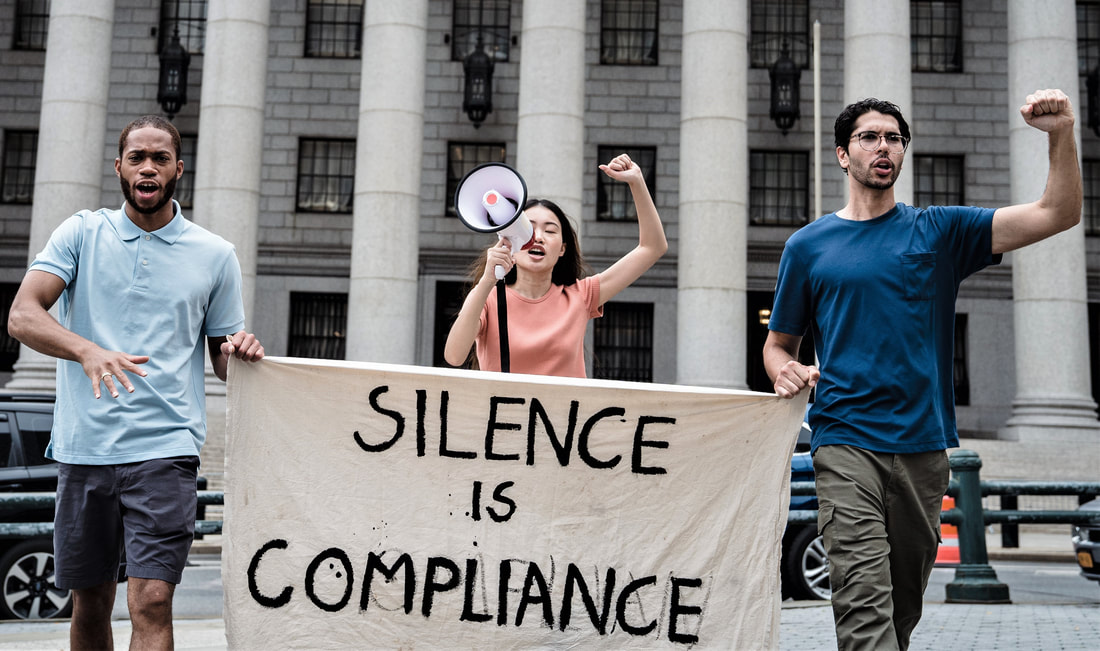 ‘I raise up my voice – not so that I can shout, but so that those without a voice can be heard.’ (Malala Yousafzai) I once had a secret meeting with the political wing of a revolutionary group from Central America, in a dark basement flat in London. But my story doesn’t start there. This was my moment. As I flicked through the pages of a UK newspaper, an article leapt out at me about the brutal civil war in El Salvador. I don’t think I’d heard of El Salvador before yet it reminded me of accounts I had read of horrific atrocities committed by the Nazis in WW2. I couldn’t change that terrible history but I could do something now. I quickly did some research then set to work straight away, creating flyers and posters and circulating and sticking them up anywhere I could think of, hoping to raise awareness and to spur others into action too. I talked incessantly to family, friends and colleagues about what was happening in El Salvador. Most responded with a bemused look: ‘Why get so wound up about a situation on the opposite side of the world and over which we have no control anyway?’ That didn’t deter me. It was my time to speak. I heard of a demonstration for El Salvador in London so I went there with a friend, both wearing our anti-war combat jackets. On arrival, we were approached by the organisers and invited to carry a banner. To our surprise, they asked us to march at the very front, directly behind a row of children who were carrying a banner too. Some 20,000 people assembled behind us. We raised our voices in safety – while human rights activists in El Salvador were having their throats cut and their bodies dumped onto the streets. Driven increasingly by vicarious trauma, I joined the El Salvador Committee for Human Rights, a team of 3 activists based in a small room, armed only with a manual typewriter. I had the privilege of volunteering alongside a humble legend, Mike Gatehouse, who had previously been captured and held by the military in Chile during the violent coup that had overthrown its democratically-elected government. My role now was to hitch-hike around the UK, encouraging and resourcing local activist groups to amplify their voice. As I look back, I realise that I didn’t have sufficient personal resilience to handle the stress, and I came close to burnout. My efforts were driven more by pain, empathy and instinct than by strategy and I’ve learned, since, the critical value of supervision. Yet Greenpeace’s profound slogan expressed our motivations too: ‘The optimism of the action is better than the pessimism of the thought.’ There are situations in which we have to act, not because we have any guarantee of success, but because somebody has to speak. [See also: Revolution; Protest; Words; Smoke; Nika; I did try]  Coaching is listening for a voice. More accurately, at deeper levels, for 4 voices. Firstly, the voice of the client: his or her concerns, aspirations, thoughts and feelings. This is the traditional focus of coaching and counselling, seeking to hear the client, to listen, pay attention, help the client to hear his or her own voice more clearly. Secondly, the voice of the client’s environment: his or her background, experience and context. It’s what Gestalt calls the field. The introjects, assumptions, cultural norms and systemic constructs that shape and speak implicitly through the client’s outlook and experience. The hidden voices behind the client’s voice. Thirdly, the voice of God: revealing, guiding, challenging and consoling. The clear, confusing, mysterious voice of God who whispers in sound, in silence, through the visible and invisible. The God who is the Word, who speaks the eternal Divine language behind human language, calling us inwards, outwards, towards and beyond. And finally my own voice: my learning, intuition, experience and discernment. It’s about listening for a resonance, a dissonance, a sense of harmony with the client, with his or her world, with God. It’s an art, a science, an energetic struggle, a dance. It’s a precious and challenging call, but the potential for transformation is significant. Calling has long-standing roots in theistic spiritual traditions, often associated with being ‘called by God’ to a certain way of life or to a specific course of action. Existential psychologists have commented on how sometimes it feels like a situation is calling for its own response from us. In both cases, the source of the calling is attributed to someone or something beyond us. It’s a phenomenon that can feel like an evocative pull, tugging at something deep within us.
I’ve experienced this many times since becoming a Christian, a strange intuition that feels beyond me, prompting or leading me in a certain direction. Sometimes it seems very clear or inspiring, at others it’s more of a vague notion, a restlessness that compels me to move or change. I’ve often experienced it in coaching relationships too, an almost irresistible impulse to speak or act that feels like revelation, an energising compulsion from the situation itself. It’s not magic, something I can make happen, something I can manufacture for myself. It’s sometimes unexpected, sometimes challenging and sometimes involves scary risk-taking. It’s not definitive either, something I can measure, test or prove in a lab. This can make the experience of calling feel mysterious, sometimes spiritual, a step in faith in response to a curious, invisible stimulus. It’s as if something ‘out there’ connects with something ‘in here’, setting up a dynamic resonance. So how to apply this in leadership and coaching? How to listen for and discern calling in the midst of so many other tasks and preoccupations that clamour for our attention? How to weigh up calling in order to act wisely? In my experience, there is no simple formula. It’s mostly about learning to be still, to live with awareness, to tune into my intuition, to be sensitive to prompts from the situation itself, to experiment and see what happens, to be open to God in prayer. I wish I could say I always follow this call. Sometimes I'm sceptical, sometimes I pull back for fear of embarrassment or failure. Nevertheless, I've seen and felt amazing things happen when I do listen and act. I would love to hear from others on this topic of calling. When have you felt called? What was the situation? What did the experience of calling feel like? What did you attribute the calling to? How did you act in response? What happened as a result? |
Nick WrightI'm a psychological coach, trainer and OD consultant. Curious to discover how can I help you? Get in touch! 
Like what you read? Simply enter your email address below to receive regular blog updates!


|
 RSS Feed