 ‘You could start a fight in an empty room, mate.’ (Allan Jones) I’ve never sought conflict. Far from it. I much prefer harmony and peace. That said, however, I can’t escape a similar calling to that which Martin Luther King once heard: ‘Stand up for righteousness! Stand up for justice! Stand up for truth!’ It’s a call that burns deeply inside of me and has done, as far as I can remember it, for my entire life. I’m pained to admit that I haven’t always followed that voice anywhere near as courageously as MLK. I haven’t always handled it with his astonishing humility and love. I’ve stayed silent when I should have spoken up or spoken up when I should have stayed silent. My words have stumbled out clumsily. I’ve caused pain where I meant to bring healing and hope. Yet, at times, this vocational stance has proved authentic, valuable and worthwhile. In my 30s, I worked for a large UK charity in the health and social care sector. As an idealistic young radical, I challenged the leadership team on numerous occasions when I believed we were compromising our values. I tried to do this with prayer and humility and out of a genuine desire to build relationship and trust. On one occasion, the leadership team decided, in view of limited budget, to increase only senior leadership salaries until it had secured sufficient funding to increase frontline staff salaries too. I argued vociferously that we should do the exact opposite – and to freeze my own salary as a first step. On another occasion, the leadership team decided to reserve all spaces in its small head office car park for executives only, given that they didn’t have time to drive around to look for parking places elsewhere. I advocated passionately that, especially in the winter months, the spaces should be reserved for female and other vulnerable staff or visitors so that they wouldn’t have to walk along dark city streets at night to their cars. On yet another occasion, the leadership team recruited a ‘hatchet man’ on temporary contract to implement a tough restructure with associated redundancies. I protested that this blunt way of approaching the change would damage relationships, engagement and trust. At times, I imagined my challenges and counter-proposals were met with deafening silence or heavy sighs – especially as I wasn’t a senior leader at the time. Nevertheless, when a serious crisis broke out between the leadership team and entire middle management, both sides to the conflict invited me to mediate as ‘the only person they could trust’. The chief executive, a man of remarkable humility, took me into his confidence and treated me like a respected thought-partner. When I moved on, the company secretary wrote to me to say he had never encountered such integrity. Even the dreaded ‘hatchet man’ wrote that he wouldn’t hesitate to employ me alongside him in any future role. Pray with humility – take a stance – speak the truth in love.
16 Comments
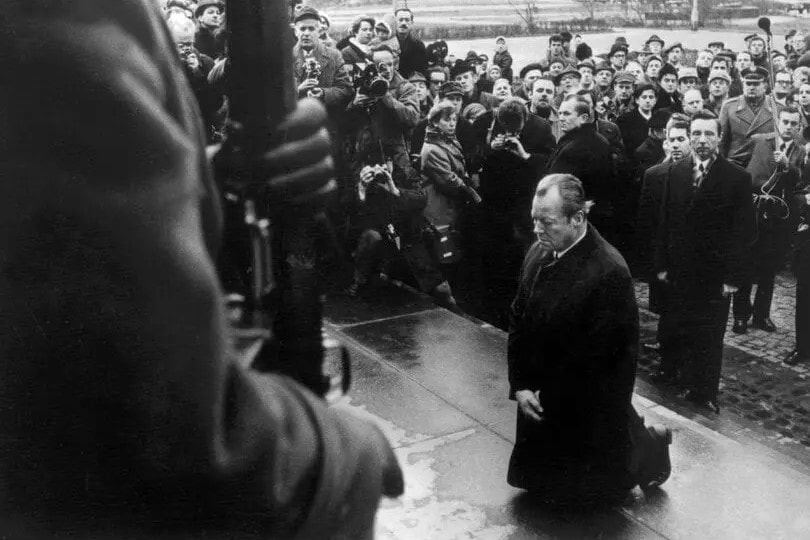 ‘To the victims of violence and betrayal, in the hope of an enduring peace.’ (Willy Brandt) Angelika gave me a gift this year of a shiny German 2 Euro coin. It was minted in 2020 to commemorate 50 years since West German Chancellor Willy Brand’s legendary ‘Kniefall’. I had heard of Willy Brandt but, I must confess, not the act that has, since, gripped my imagination. The German word Kniefall means, quite literally, to fall to one’s knees. I’m especially indebted to Valentin Rauer’s exceptional social-psychological study, Symbols in Action (2009), of what took place in that extraordinary moment in world history. I’m curious about what it meant and what made it so powerful. Brandt visited Warsaw in Poland, 25 years since the end of World War 2, on a mission to seek post-war reconciliation. Poland, including its Jewish population, had suffered horrific genocidal brutality at the hands of the Nazis. At the Monument to the Heroes of the Jewish Ghetto Uprising (against their Nazi oppressors in 1943), with a crowd of media reporters watching, Brandt suddenly and unexpectedly fell to his knees. He stayed there, in silence, as those around him looked on in amazement. It was an astonishing example of an action speaking far louder than words. At a political level Brandt, as Chancellor, represented West Germany. At a personal level, during the war, Brandt had been an anti-Nazi activist. The imagery of Brandt’s Kniefall, as an act of penitent humility that acknowledges guilt and seeks ‘forgiveness for an unforgivable past’ (Rauch), resonated deeply in a prevailing Christian culture. The symbolism of ‘the innocent (who) takes up the burden of the collective’s sin, thus redeeming the nation’ (Rauer) reflected Jesus Christ’s death on the cross. Brandt was in the square from which Jews were deported to concentration camps. For me, the most striking and moving dimension of this event was Brandt’s own reflection on the spontaneity and authenticity of his act: ‘Faced with the abyss of German history and the burden of the millions who had been murdered, I did what people do when words fail us.’ It paints the picture of a human being, beyond the public trappings of a politician, who allowed himself to feel empathy and brokenness, to take undefended responsibility and to reach out in peace. It transformed the trajectory of Cold War politics then. How desperately we need leaders like that now.  ‘It is always much more difficult to sing when the audience has turned its back.’ (Calvin Miller) Early in my career, I worked for an over-zealous manager who would sit at the front while I was speaking at events; looking impatient, rolling her hands and tapping her watch. Perhaps she was worrying, unnecessarily, whether I would keep to time. I imagine she thought she was being helpful. I learned then that a look of disapproval or distrust is sometimes all it takes to sap a person’s confidence or to ruin their performance. An Australian pop group reflected a similar feeling and impact in its half-pleading song lyric, ‘I can't do well when I think you're going to leave me, even though I try’. (Empire of the Sun) What a stark contrast a word of encouragement can be. Some years later, I was invited to speak at a prestigious international conference. I had grown in confidence, yet there was something about this event that evoked all kinds of anxieties within me. As I sat alone in the VIP lounge beforehand, I could see my hand trembling uncontrollably as I tried hard to hold a hot drink. When I stepped nervously into the auditorium and onto its expansive, spot-lit stage, I could see smartly-dressed delegates being ushered into the room and handed very professional-looking folders as they looked to find a seat. My legs felt like jelly, so I sat down on the steps beside the podium and took deep breaths to try to relax myself. At that moment, a tiny black woman walked directly up to me and smiled brightly. She announced enthusiastically that she has travelled all the way from the Solomon Islands to be here, and was surprised and delighted to read in the brochure that I too was a ‘follower of Jesus’. I thanked her warmly for introducing herself. Her face shone like an angel. ‘I will be sitting in the centre of the room’, she said, ‘and praying for you continually!’ My knees found strength. The speech went well. When have you felt encouraged at work? How did affect your performance?  ‘Think of your techniques as toys rather than tools.’ (Brian Watts) This was an insightful, inspiring and innovative coach who had a gift for working at the learning edge, the leading edge, the sometimes bleeding edge. I had the pleasure of working with him as a close colleague and as a client. For me, it was a profound, at times disconcerting, and yet often invigorating learning experience. It challenged my ingrained, default ways of thinking about and doing my work. It also gave me my first experiential taste of the power of Gestalt. His approach started with a simple and open invitation, ‘Be free, creative and experimental. See what happens. Let the child play!’ His conviction was that transformation takes place (a) through experiential learning, and (b) at what is, for the client, his or her own learning edge. It’s that frontier horizon at which we place our self- and culturally-imposed limits. It’s the stretched and stretching place where we may discover our own subconscious psychological defences too. I talked about a forthcoming meeting with an executive team. I was new in my career and found the anticipation of this encounter very anxiety-provoking. The coach invited me to leave the room, then to step back in as if entering the executive meeting room itself. When I did so, he observed (to my surprise) that I was holding my hand across my chest, as if protecting my heart. ‘How would it be if you were to reveal your heart in that meeting?’ I did so, and that transformed everything. In the creative, experimental spirit that lays at the heart of Gestalt coaching, he reminded me, ‘Sometimes these things will fall flat. It’s always a leap of faith.’ It’s a suck-it-and-see approach: try something new and see what may emerge into awareness. It taught me that learning has rational, emotional, intuitive, imaginative and somatic dimensions. I discovered I stand to learn most when I take a risk, when I dare to step out and beyond my natural-instinctive learning mode. Curious to experience the power of Gestalt? Get in touch! [For more examples of Gestalt coaching in practice, see: Just do it; Crab to dolphin; Let's get physical]  ‘It’s a question of what the relationship can bear.’ (Alison Bailie) You may have heard the old adage, the received wisdom that says, ‘Don’t try to run before you can walk.’ It normally refers to avoiding taking on complex tasks until we have mastered simpler ones. Yet the same principle can apply in relationships too. Think of leadership, teamworking, coaching or an action learning set; any relationship or web of relationships where an optimal balance of support and challenge is needed to achieve an important goal. Too much challenge, too early, and we can cause fracture and hurt. It takes time, patience and commitment to build understanding and trust. I like Stephen Covey’s insight that, ‘Trust grows when we take a risk and find ourselves supported.’ It’s an invitation to humility, vulnerability and courage. It sometimes calls for us to take the first step, to offer our own humanity with all our insecurities and frailties first, as a gift we hope the other party will hold tenderly. It's an invitation, too, for the receiver to respond with love. John, in the Bible, comments that, ‘Love takes away fear’. To love in the context of work isn’t something soft and sentimental as some cynics would have us believe. It’s an attitude and stance that reveals itself in tangible action. Reg Revans, founder of action learning, said, ‘Swap your difficulties, not your cleverness.’ A hidden subtext could read, ‘Respond to my fragility with love, and I will trust you.’ I joined one organisation as a new leader. On day 3, one of my team members led an all-staff event and, afterwards, she approached me anxiously for feedback. I asked firstly and warmly, with a smile, ‘What would you find most useful at this point in our relationship – affirmation or critique?’ She laughed, breathed a sigh of relief, and said, ‘To be honest, affirmation – I felt so nervous and hoped that, as my new boss, you would like how I had handled it!’ In this vein, psychologist John Bowlby emphasised the early need for and value of establishing a ‘secure base’: that is, key relationship(s) where a person feels loved and psychologically safe, and from which she or he can feel confident to explore in a spirit of curiosity, daring and freedom. It provides an existential foundation on which to build, and enables a person to invite and welcome stretching challenge without feeling defensive, threatened or bruised. How do you demonstrate love at work? What does it look like in practice?  ‘I turned my head and saw yet another wisp of smoke, on its way to nothingness…’ (King Solomon) On three separate occasions, a female grass roots activist in the Philippines was followed at night by strangers: men on motorbikes. As she walked alone, they would ride slowly and menacingly behind her, aiming to threaten and intimidate her into silence. She had taken a very public stance against corruption in high places – a stance that, for other activists in her country, had resulted in a deadly blade or a bullet in the back from a passing motorcyclist. Undeterred, this young woman turned around and confronted the bikers, fearlessly: ‘Even if you kill me, you can’t take my life.’ She’s a radical follower of Jesus who has chosen a determined, startling and courageous life stance at the cutting edge of faith. It stands in stark contrast to the greyness of nothingness that the writer of Ecclesiastes speaks to at the start of this blog. It’s a spiritual-existential stance that holds the potential to transform…everything. Zoom out now, back to our own lives. Strip back the trappings and tear away the superficial facades. What lays behind and beneath for us? This is the deep stuff of spiritual and existential coaching. It touches on fundamental questions: identity, meaning, purpose and stance. ‘Human life must be risked if it is to be won.’ (Jürgen Moltmann). ‘If you risk nothing, then you risk everything.’ (Geena Davis). I don’t want my life to be a wisp of smoke. You? (See also: Deep; Spirituality in coaching; Existential coaching)  ‘I know that I know nothing.’ (Socrates) Action Learning is an opportunity to receive questions. It’s founder, Reg Revans, advocated: ‘Swap your difficulties, not your cleverness.’ Revans’ approach was a radically different philosophy and praxis that stood in contrast to conventional didactic methods at the time. It affirms the value of not-knowing, curiosity and exploration. It facilitates a grappling with questions that have no easy answers and creating experimental solutions; without a pressure to hide from or impress peers. A transformational dimension of Action Learning is the power of vulnerability in building trust. If I model an authentic openness, a willingness to share those issues and experiences that I find most perplexing or troubling in my own work, it may invite others, in Susan Scott’s words, to ‘come out from behind (themselves) and make it real’ too – if they choose it. Stephen Covey expresses this dynamic well in his insight that, ‘Trust grows when we take a risk and find ourselves supported.’ I like the questions that Angie Bamgbose poses to herself in her insightful Action Learning blog, Race, Power and Privilege: ‘What is my gift? What am I still confused about? What have I learned? What will I do?’ It models the spirit of courage, humility and reflexivity that lays at the heart of Action Learning practice. It reminded me of guru Rick James’ opening words at an INTRAC webinar this year, looking at the future of humanitarian work internationally: ‘There is so much I don’t understand’. How do you use questions to stimulate reflection, insight and action? How do you handle personal and cultural pressures to present a front, to impress or to ‘perform’? (See also: Not-Knowing; Managing our Not-Knowing; Action Learning)  ‘When the bombs were falling like rain, Jennie stayed here with us.’ As a leader in international NGO, Tearfund, Jennie had always struck me as a quiet and unassuming person. We visited community rebuilding initiatives together in Lebanon just after the harsh and brutal civil war. Amidst shattered buildings, lives broken by sectarian conflict, aerial bombardment of the Beirut power station (just as we arrived) and Syrian ‘peacekeeping’ troops everywhere, we met with Christian leaders who recounted countless stories of heartache and hope. One of the things that struck me most was their deep reverence and respect for Jennie. Whenever she spoke, they listened with profound attention. Curious about this, I asked one of the leaders about it afterwards. He replied, ‘During the war, most NGOs withdrew because it became too dangerous for them to stay. Jennie was different. She refused to abandon us. When the bombs were falling like rain and we had nowhere else to run to or hide, Jennie stayed here with us.’ I felt completely speechless, humbled and amazed. I imagined myself in that same situation: how I would almost certainly have fled for my own safety – and have found or created very good reasons to justify myself for doing so. Yet what an impact now. The leadership and influence that Jennie was able to bring to this work by having been-with; not based on any hierarchical status, power or authority she held, but on a deep and incarnational, presence, relationship and trust.  ‘Those who hope in Christ can no longer put up with reality as it is but begin to suffer under it and to oppose it. Because I believe in eternal life, I shall be active for the life of the people. Because I hope in the resurrection, I shall take part in the revolt of the people against all deadly oppressive powers.’ (Jürgen Moltmann) It was tough living under martial law. Her father and neighbours were working hard in the fields during harvest time. As evening approached, without realising it, they were out slightly later than was allowed under the imposed curfew. When soldiers appeared, the farmers didn’t expect to have their hands and feet tied or to be wrongly accused of insurgency. Her father, now badly beaten and blooded, was dragged home to his wooden hut and thrown down a bank. She was only 5 years old at the time and, witnessing this horror, in desperation picked up a stone and threw it at one of the soldiers. He pulled out a gun, held it to her head and said, ‘I could kill you.’ Only the intervention of another soldier saved her: ‘Leave her. She’s a child.’ As I listened to this simple yet harrowing account, I could only imagine how this incident, this trauma, could have impacted on this young girl’s life. Certainly, as an adult, it has influenced her passion and stance against injustice, particularly violence in whatever form – whether physical via war, social-psychological via exclusion or insidious via corruption – against the poorest and most vulnerable people. Some years later, her uncle, a leader in a remote village, opposed the unethical practices of a powerful business and paid for it with his life. She too was hunted by a death squad for challenging a corrupt government official in front of the media. Only after he too was murdered, could she and her family return safely to their home. It's a world that terrifies me. I don’t know if I could find the courage to stand firm on my beliefs and values in such circumstances. I’m afraid that I would shrink back, try to protect myself – and find ways to justify it. Later in her childhood years, this girl met Mother Teresa of Calcutta who placed her hands on her head and prayed for her. I do wonder if something profoundly spiritual happened in that moment. She throws her life on Jesus – for others, in love – relentlessly and at significant personal cost. When I appeal to her to keep safe, she cautions me to beware of being too safe: ‘If you cling to your life, you will lose it; but if you give up your life for Jesus, you will find it.’ Jesus is her hard-edged hope. She takes him at his word.  ‘The opportunity to make effective personal choices is highly unequal.’ (Robert A. Dahl - After the Revolution) New Years’ Resolutions. A time and practice in Western cultures when some of the more reflective or impulsive among us will commit to do something new. It could be, for instance, a new relationship, a new job, a new home, a new diet or a new fitness routine. For many people, very soon after having made a decision, the resolve will dissolve and be lost in the mists of time. Yet central to this idea of resolution is the notion of personal choice and, with it, the principle that I can succeed in achieving what I choose – if I’m willing to do whatever it takes. I often create (prayerfully) a list of key aspirations at the start of each year, then put practical steps in place so that, all things being equal, I will be able to look back at the end of that year and see that I have fulfilled them. The goals are intentionally inspiring and stretching. They are, with God’s help, within my grasp and, therefore, possible. On the whole, this discipline works by ensuring focus, parameters and accountability. It also centres on people and things that are genuinely important to me and, thereby, taps into values, motivation and determination. We can think of this choosing-acting-influencing phenomenon as exercising personal agency. Shaun Gallagher describes this as, ‘the sense that I am the one who is causing or generating an action’. ‘I can choose’ is a profound existential, psychological and political statement and stance. It means I can break out beyond the apparent default of my circumstances. We hold the potential to be catalysts of real change in the world, within ourselves as well as in broader relationships and situations – and this brings opportunity and responsibility. I can choose and you can choose. I think vividly of Jasmin in the Philippines, a poor woman among the poor who chooses to follow Jesus’ call and example, whatever the cost. Rather than allowing herself to be limited by her circumstances or by expediency, she exercises radical personal agency and transforms everyone and everything in her path. Malala Yousafzai and Greta Thunberg are famous examples of women too who take personal choice, action and influence seriously – and, similarly, at considerable personal risk. There are wider dimensions. A person's sense and scope of agency are affected by structural factors that transcend the individual, e.g. social status; wealth; education; gender; ethnicity; culture. Mustafa Emirbayer and Ann Mische observed that a person’s lived experience limits what possible alternatives or future scenarios he or she is able to imagine. Paulo Freire proposed, on a similar basis, that critical consciousness (‘conscientisation’) is a necessary condition for people to exercise freer choices and agency for change. I worked with a client from Myanmar and asked her what she dreamed of. She looked at me blankly then responded that she was unable to conceive of a different reality to the one that she had lived until now. She felt crushed by the mental and practical constraints of living as an ethnic minority in a country dominated by a military dictatorship. The impact of unequal and unjust social-political power is not a fixed determinant of agency – but the stark psychological and tangible inequalities of choice and opportunity it engenders are significant. Other influences include personal confidence, competence and capacity. If a person operates psychologically and relationally from a secure base with trust and support, he or she is more likely to choose to take a positive risk. If, conversely, someone is and-or feels alone and has experienced or anticipates unfair discrimination, negative evaluation or other painful consequences, to act can feel hazardous – especially if the stakes are high. Agency can demand energy, courage and resilience. A person may not (yet) feel ready, willing or able to take that step. If a client is unaware of or avoiding personal agency, William Glasser suggests stimulating his or her sense of reality, responsibility and relationship in order to enable more life-giving choices. If stuck in a pattern of apathy or passivity, John Blakey and Ian Day propose offering high challenge with high support. If we risk inadvertently colluding with or disempowering a client, Reg and Madge Batten advise focusing attention on what the person can do for him- or herself and, only after that, what we could do by agreement with them, or on their behalf. Viktor Frankl, victim of Nazi persecution concluded that, fundamentally: ‘The one thing you can’t take away from me is the way I choose to respond.’ In our personal, social and political lives, we can see how a person’s choices, actions and influence are affected by a diverse range of factors. These include the privileges a person may hold (or not) and the opportunities he or she has benefited from by birth, background or context. Jesus – help me choose this year to exercise my own agency for the life and liberation of others. We can be hope. (Would you like to discover how to exercise greater personal agency? Get in touch!) |
Nick WrightI'm a psychological coach, trainer and OD consultant. Curious to discover how can I help you? Get in touch! 
Like what you read? Simply enter your email address below to receive regular blog updates!


|
 RSS Feed