 ‘No matter how much we may think we have an accurate sense of ourselves, we are stymied by the fact that we are using our own interpretive filters to become aware of our own interpretive filters – the pedagogic equivalent of trying to see the back of one’s own head while looking in the bathroom mirror.’ (Stephen Brookfield) Critical reflection can enable a coach, and a client, to move beyond addressing an immediate issue – say, a challenge or an opportunity – that lays before them to consider themselves, the context(s) in which they find themselves and how it impacts on their relationship(s), what they (and others) perceive, how they (and others) construe it, what value they (and others) attribute to it and what they (and others) do (Pockett, Lindsey & Giles). We could think of this as a bit like stepping outside of a circle, the circle representing that which we have agreed – in the sense of giving conscious or subconscious assent – defines the nature, focus, scope and meaning of an issue, to explore what lays above, below and around that circle. A challenge lays in how to do this, how to disengage and disentangle ourselves enough to view ourselves, the context and the issue through fresh eyes. To assist us in this venture, Fook offers critically-reflective questions to enable us, and others, to step outside of the box. Here are some examples: What am I/the client assuming? How am I/the client influencing the situation? What preconceptions do I/the client have and how might these influence what I/the client do or interpret? How is my/the client’s presence making a difference? What sort(s) of power do I/the client have? Touching further on broader and embedded issues of power and privilege, Smith invites us to pose critical questions such as, Who benefits in this situation? and Whose voices are being omitted? Chan and Mak identify the potential for paradigm shifts and earthquakes in social-political structures if this is applied to practice: ‘(It) can liberate people from oppressive ideologies and empower them to resist social injustice.’ What have been your experiences of critical reflective practice? How did you do it? What difference did it make?
3 Comments
 ‘We're fascinated by the words – but where we meet is in the silence behind them.’ (Ram Dass) I remember my first experience of haggling over the price of a leather belt in a Palestinian marketplace. I was a teenager at the time and I found this approach to buying and selling novel and entertaining. The smiling street vendor played the game skilfully. I asked, ‘How much?’ to which he responded, '$6.’ ’$6?’ I replied, ‘I could get the same belt at another stall for $1. How about $2?’ ‘$2?’ He replied, ‘Please don’t insult me. It cost me more than that to make it. As a special deal, however, I’ll give it to you for $5.’ ‘$5?’ I replied, ‘The most I would pay for it is $4.’ ‘$4?’ He replied. ‘Don’t you realise I have a family and children to feed?!’ He grinned. We closed at $3. To a Westerner, where buying and selling is typically more transactional than relational, this toing and froing can feel like a manipulative game; frustrating, bordering on dishonest and time-wasting. That’s mostly because we tend to miss the underlying cultural meaning and purpose to this type of engagement. I met recently with an international team from USA, Netherlands, Jordan and South Africa. They are part of a Christian organisation and were keen to identify and work through some cross-cultural and relational challenges. I decided to share a short passage from the Bible with them, then to invite them to discuss what sense they made of it: “Jesus withdrew to the region of Tyre and Sidon. A Canaanite woman from that vicinity came to him, crying out, ‘Lord, Son of David, have mercy on me! My daughter is demon-possessed and suffering terribly.’ Jesus did not answer a word. So, his disciples came to him and urged him, ‘Send her away, for she keeps crying out after us.’ He answered, ‘I was sent only to the lost sheep of Israel.’ The woman came and knelt before him. ‘Lord, help me!’ she said. He replied, ‘It is not right to take the children’s bread and toss it to the dogs.’ ‘Yes it is, Lord,’ she said. ‘Even the dogs eat the crumbs that fall from their master’s table.” And now to the critical closing: “Then Jesus said to her, ‘Woman, you have great faith! Your request is granted.’ And her daughter was healed at that moment.” (Matthew 15:21-28) To the Westerner who views language and transactions in literal, linear, straight lines, Jesus’ initial responses to the woman are shocking. We take his opening action as his definitive stance. We don’t see the smile on his face or the glint in his eye, or understand the movement as the interaction progresses. We may assume the story is written to affirm the woman’s perseverance. We may think she has changed his mind. We are likely to miss the Semitic ritual of building or navigating a relationship. The Jordanian participant saw this immediately. The others looked surprised. (I must confess I didn’t understand this, too, until a Kurdish-Iranian friend had explained this dynamic to me). The cross-cultural implications are clear. If I judge your actions by unknowingly mis-inferring your intentions (being influenced subconsciously by my own cultural assumptions), all kinds of misunderstandings and tensions can arise. It cautions me-us to approach people and groups from different cultures with an open mind, a spirit of curiosity and a great deal of humility. Bottom line: We’re not only negotiating a price; we’re also negotiating a relationship.  ‘Intuition is like reading a word without having to spell it out.’ (Agatha Christie) I had the privilege of training an inspiring, cross-cultural group of participants in South Africa, Rwanda and the UK this week who work in different roles in the same international non-governmental organisation (INGO). This online Action Learning Associates programme was designed to enable them to facilitate Action Learning sets (that is, groups) confidently and effectively. (If you’re unfamiliar with the concept of Action Learning, it’s a semi-structured, small-group, peer-coaching process that’s used widely in leadership and management development programmes and as part of wider organisation development (OD) initiatives). One of the areas we touched on during the training event is the value of drawing on intuition when facilitating groups. We could consider the facilitator’s role simply in terms of a series of tasks, e.g. introducing a meeting; leading a check-in; contracting ground-rules; guiding the group through the sequential steps of an Action Learning process; facilitating a review at the end. These are important elements that we learn to handle skilfully. At a deeper level, however, we can learn to tune into our intuition. This will help us to discern, for instance, unspoken issues; underlying group dynamics; or when a person-group is stuck or ready to move on. Intuition can feel mysterious, a sense of ‘knowing’ that we may experience bodily or as a feeling rather than as a rational concept in our mind. One of most mysterious experiences I had was when training a group of church and community leaders in Action Learning facilitation. When I first encountered one of the participants, the word ‘Ruth’ kept coming to mind. I mentioned this to him very tentatively and he looked astonished. Apparently, he was about to complete a PhD study on the book of Ruth in the Bible. I had no idea. For me, spiritual discernment sits close to intuition. I always pray deeply before coaching or facilitating a set. How do you draw on intuition in your own life and practice? I’d love to hear from you!  ‘Sleight of hand, of course, is not magic, but a skilled use of distraction to keep the ‘mark’ from noticing the real act that is being done. It takes advantage of a natural tendency to follow the obvious and to miss the more important thing that is carefully obscured.’ (Colin Harris) Geopolitics is like a game of chess in which half the pieces are invisible and nothing is what it seems. Like a magician that tricks by misdirection, we can find our attention drawn to the person or the issue that lays immediately in front of our eyes and miss the vital background. In WW2, why did the USA use devastating nuclear weapons against Japan? To prevent further loss of American lives by avoiding having to invade the Japanese homeland? Maybe. To fire a shot across the bow of Stalin and the rapidly-expanding Soviet Union? Almost certainly. On 9/11, why did Al Qaeda attack the twin towers and other symbolic targets in the USA? To strike a blow against the ‘Great Satan’? Maybe. To provoke an over-reaction from the USA that would, itself (they hoped), radicalise Muslims worldwide against the liberal West? Almost certainly. In 2003, why did the USA and its allies invade Iraq? To remove Saddam Hussein? To eliminate an imagined risk of ‘weapons of mass destruction’? Maybe. To secure US' and allies’ future oil supplies against a rapidly-developing China and its projected energy demands? Almost certainly. In 2022, why did Russia brutally invade Ukraine? To restore the power and prestige of the Soviet empire? To defend pro-Russian East Ukraine from ‘Ukrainian aggression’? Maybe. To fire a shot across the bow of an eastward-expanding NATO and EU? Almost certainly. On October 7, why did Hamas attack Israel so murderously? To punish Israel for its oppression of Palestinian people? Maybe. To provoke an over-reaction from Israel that would, itself, stop Saudi and other Muslim states normalising relations with Israel? Almost certainly. Why has Israel since retaliated against Gaza with such overwhelming force? To destroy Hamas and its military capabilities? To secure the release of the remaining Israeli hostages? Maybe. To fire a shot across the bow of Iran, an ever-increasing threat in the Middle East? Almost certainly.  ‘Curiosity killed the cat, but for a while I was the suspect.’ (Steven Wright) Action Learning facilitators sometimes feel anxious if there are prolonged periods of silence in a group, or if an individual is particularly quiet. They may assume, for instance, that the person is uninterested to engage with the group or the process. I had that experience once (online) where a participant sat throughout a round wearing headphones, nodding and swinging in his chair as if to music. When I asked if he had any questions, he clearly had no idea what the presenter had been talking about. I addressed this with him directly after the round, checked if there was anything he would need to be and feel more engaged, then agreed that he would leave the set. That said, there are a wide range of potential factors that may influence if and how a person engages in a set meeting and, at times, different reasons for the same participant during different rounds. I will list some of them here as possibilities: if a person has been sent to a set, rather than has chosen freely to join it; if there is formal or cultural hierarchy within the group; if there has been insufficient attention paid to agreeing ground-rules for psychological safety; if building relational understanding and trust has been neglected; if a person doesn’t like someone else in the group, or fears negative evaluation by others in the set; if a person lacks confidence. There are other possibilities too: if a person has an introverted preference and processes thoughts and feelings internally; if a person has a reflective personality and needs more time to think; if a person doesn’t feel competent with the language or jargon being used; if the person can’t think of a presenting issue or a question; if last time the person spoke up in a group meeting, it was a difficult experience or had negative consequences; if a person is preoccupied with issues or pressures outside of the meeting; if a person is distracted mentally or impacted emotionally by something that happened before the meeting, or is due to happen after it. So, what to do if a person is completely silent in a set? Here are some ideas, to be handled with sensitivity and, if appropriate, outside of the meeting: take a compassionate stance – there may be all kinds of reasons for the silence of which you are unaware; avoid making judgements – silence does not necessarily indicate disengagement; be curious – ask the person tentatively, without pressure, if any issues or questions are emerging for them; avoid making assumptions – ask the person what the silence means for them and if there’s anything they need; have an offline conversation with the person – if their silence persists for more than one meeting.  ‘Hippopotomonstrosesquippedaliophobia is one of the longest words in the dictionary, and ironically, it means the fear of long words. It originally was referred to as Sesquipedalophobia but was changed at some point to sound more intimidating.’ (Yalda Safai) You couldn’t make it up. Who would create a word like that – and why? One theory is that all professional fields create their own jargon, partly as a convenient shorthand for people working in that field and partly as an implicit status symbol. After all, if I know what the words mean and you don’t, that places me on a pedestal. It signifies I’m an expert – and you’re not. I did some work with a professional UK charity that wanted to change its brand tone of voice. (There you go: a bit of brand jargon). 'Tone of voice' means something like 'organisational personality'. Essentially, they wanted to change the way they express themselves in order to change the way in which they are perceived and experienced by those they want to work with. As part of the change, they decided to write in ways that one might ordinarily speak. It’s one of those curious cultural things in English, like in some other languages too, that we tend to write in one way and speak in another, even using different words to mean the same thing. Spoken words tend to be simpler and shorter. So, they set about de-jargonising their written jargon. Here are some examples they used to illustrate this principle, replacing written language with spoken – request: ask; require: need; advise: tell; retain: keep; endeavour: try; terminate: end. This made their communications feel less formal and more personal and conversational; especially when they also used first and second person (I/we/you) pronouns and active voice. (See how I slipped in a bit of grammatical jargon there?). So, language is important. A change of language can reshape the ways in which people and groups perceive, experience and relate to us, and to one-another. Language carries subtle emotional and cultural associations too, influencing how we (and others) feel, what we believe – and how we are likely to respond.  ‘Uncertainty is the only certainty there is, and knowing how to live with insecurity is the only security. (John Allen Paulos) I had an important conversation with an impressive young woman from Malaysia this afternoon. As we shared examples of our various cross-cultural experiences with people and groups from different parts of the world, she mentioned an impact of a Judeo-Christian worldview on culture that I hadn’t really considered before. A belief that God created the world, both with a purpose and with a fundamental principle of order to it, leads to an assumption that things happen for a reason and, furthermore, that there are causal factors that lay behind whatever does happen. Take now, by contrast, an alternative and, say, fatalistic belief system in which things just are as they are. I remember speaking with a community development worker from the UK who worked with rural leather-working communities in Nepal. When he attempted to introduce methods such as adding lime during treatment to preserve the leather, and furthermore demonstrated the results, the local people didn’t appear to see any connection between adding of the lime and the absence of mould. It was as if whatever happened (or not) just happened (or not). Drawing a parallel, this woman today went on to comment that older generations often criticise the lack of stickability of today’s younger generations and attribute it to, say, fickleness, laziness or a lack of resilience. The former grew up with mantras such as, ‘If you study hard, you’ll get a better job’, or, ‘If you work hard, you’ll get a promotion/better pay.’ And often this was the case. Yet to young people now, the world looks and feels chaotic and unpredictable. It can often seem that to succeed (or not) is simply a matter of privilege or luck. 'So what’s the point of putting hard work in?' This contemporary contextual and cultural phenomenon is, alarmingly, a socio-psychological breeding ground for fundamentalist and reductionist ideologies, including in political spheres, that offer, as if by some divine miracle, a reassuring sense of simplicity, certainty, purpose and belonging. If a person or group feels all at-sea in life and an overwhelming sense of anxiety that may go with it, they may well grasp instinctively at and cling onto whomever presents a vision of safe and solid ground. Against this backdrop, false messiahs are emerging as leaders all over the world.  ‘Is he – safe? I shall feel rather nervous about meeting a lion.’ ‘Safe? Who said anything about safe? Of course he isn’t safe. But he is good.’ (C.S. Lewis: The Lion, the Witch and the Wardrobe) I was 8 years old when the teacher asked us, a classroom of children, to sit on the floor while she read to us the next chapter of a novel, ‘The Lion, the Witch and the Wardrobe’. If you know the book, it was the part where Aslan the lion (which, I discovered later, the author had used to depict Jesus) appears in Narnia, a mythical world that represents this world. It's a beginning of real hope. This snow-covered land, which hitherto had been trapped under a curse of perpetual winter, is beginning to thaw. Meanwhile, the antagonist, an evil witch (depicting Satan), comes across a small group of woodland creatures enjoying a party to celebrate. She flies into a rage, interrogates them harshly and uses her magic powers to turn them into stone. At that awful and unexpected moment, I remember bursting into tears. As a child, I was horrified that, just as things had started to look up for these innocent animals, their lives and hopes had been shattered. It felt like a moment of despair for them – and for me. (A therapist-supervisor commented recently that little wonder most of my subsequent adult life has been spent in community work, human rights and international development). Today as I, along with Christians across the world, reflect on Jesus’ death on the cross, I’m reminded again of terrible injustice and violence against the innocent. I often identify more with Edmund than with Peter in Lewis' drama, yet what matters most is Aslan. It's He who breaks the power of the witch. 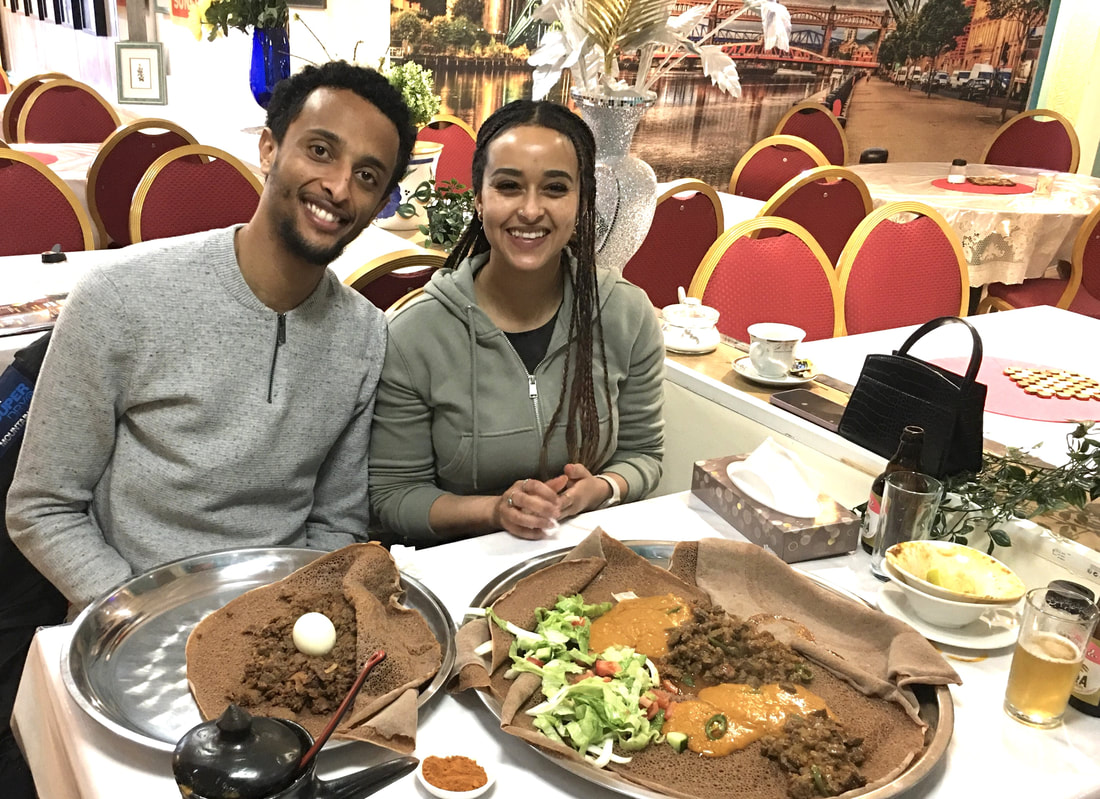 ‘Chance is perhaps the pseudonym of God when he doesn’t want to sign.’ (Anatole France) I enjoyed a very tasty Eritrean meal with an inspiring young couple today. I had met this bright young man on a plane on my way to Germany last year and we had chatted throughout the flight. It turned out his equally-talented partner is involved in very similar work to my own, including internationally, so we agreed to keep in touch with each other on our return to the UK. As we met up again for the first time today, we talked about our shared faith in Jesus and his profound significance in our lives. We talked, too, about ways in which we’ve witnessed his mysterious power at work. As I listened to this couple's stories and experienced their generosity and warmth, I had a deep sense this encounter was far more than coincidence. When have you experienced encounters that somehow felt sacred?  '95% of what we think we know, we have simply accepted from what other people have told us.' (Dennis Hiebert) Nothing adds up. How can we identify hidden assumptions, implicit agendas and vested interests that lay behind what we see, hear and read in the media? Perhaps the answer to this question has rarely been so critical. Democracy and social cohesion within and between peoples and nations are threatened by manipulation and misrepresentation of what we may ordinarily regard as truth. Following writer Mark Twain, actor Denzel Washington commented famously, ‘If you don’t read the news, you’re uninformed. If you do read the news, you’re misinformed.’ Take international news in the UK. Why are we so focused on Russia-Ukraine and Israel-Gaza? Why haven’t we noticed, apart from the occasional glance, the terrible civil wars in Sudan, Myanmar or Democratic Republic of Congo? Why do we call Russia’s brutal intervention in Ukraine a ‘full-scale invasion’? Why do we assume that increasing NATO size-spend is the only solution? If Israel’s bombing is indiscriminate, why has it killed, proportionately, so few ‘adult men’? Why didn’t we see outraged street demonstrations against horrific, widespread atrocities by Daesh? These are profoundly important, deeply complex and extremely painful issues and we rarely have access to the underlying research or information that could help us, as ordinary and concerned citizens of the world, to discern and decide how to act. We are presented with multiple, competing viewpoints and demands and this can feel both perplexing and paralysing. I don’t know the answers to such questions yet I do believe they should play at least some part in shaping my response. I will share some considerations that may help us to avoid sleepwalking blindness. As we’re exposed to news reports, what are we noticing and not noticing? How far does what we’re noticing appear to confirm what we already believe or want to believe? How open are we to having our assumptions, our preconceived beliefs and ideas, challenged to reveal something different or new? Why is the news presenter or media channel presenting this particular story or angle? What do they want us to believe, think, feel or do? Who or what is being excluded by the reporter’s narrative? Whose voice, perspective or experience is being ignored or filtered out? Behind the scenes: who owns and-or funds the media channel, the presented report or the research that underpins it? How rigorously are research methods tested to avoid implicit bias? Are views and experiences presented in a report genuinely representative of a wider and diverse population, or different sides to a conflict? In interpreting statistics, is a reporter presenting a case selectively, or cherry-picking results to show or advocate a particular stance? In short, be sceptical – and look for evidence that supports or contradicts the research-reporter’s ‘news’. |
Nick WrightI'm a psychological coach, trainer and OD consultant. Curious to discover how can I help you? Get in touch! 
Like what you read? Simply enter your email address below to receive regular blog updates!


|
 RSS Feed