 ‘Human existence is always directed to something, or someone, other than itself – be it a meaning to fulfil, or another human being to encounter lovingly.’ (Viktor Frankl) Existential coaching is a powerful and introspective approach that can empower individuals and groups to confront life's fundamental questions, find meaning and embrace personal and social responsibility. Rooted in existential philosophy, this coaching method guides clients through self-exploration, enabling them to confront their fears and uncertainties and make authentic choices aligned with their values. Here are some examples of existential coaching questions:
Existential coaching recognizes that we all face inherent dilemmas, and embracing these challenges can lead to personal and social growth. Using this approach, the coach serves as a supportive ally, helping clients to confront their concerns, explore their inner personal-cultural truths and develop a deeper understanding of themselves. The client can learn to navigate life's complexities with greater clarity and intention, leading to a more meaningful and purposeful life. [Further reading: Monica Hanaway, The Handbook of Existential Coaching Practice (2020); Yannick Jacob, An Introduction to Existential Coaching (2019); Emmy van Deurzen & Monica Hanaway, Existential Perspectives on Coaching (2012)]
20 Comments
 ‘The question is: how to ensure a healthy life-life, work-work and life-work balance?’ It felt like losing the plot. Spinning plates isn’t unusual or new yet, as a freelancer, the tell-tale signs were beginning to show. I met with my coach, Sue, to re-ground myself and my work before, like some scene from a Greek wedding, plates began to fall and smash in pieces around me. Sue asked me, ‘If you were to conduct an appraisal of your life and work for the past 12 months, what would the highlights be? How would you rate your life and business health and performance?’ My mind immediately went blank. I had allowed myself to become so busy that the year was a total blur. So, I sat down that evening, took out my diary and created a simple summary. I discovered to my surprise that I had worked with people from 150 organisations (charities; NGOs; churches; public sector, e.g. social services, health, education, police); from 35 countries; 60 coaching sessions; 30 training workshops; 25 action learning set meetings; written 25 articles and blogs; provided ad hoc TESOL support for refugees and asylum seekers; and, by God’s amazing grace and the generosity of family and friends, sent £23k in support to the poorest and most vulnerable in the Philippines. Strikingly, until I did this review, I had no idea. I had lost sight and sense of the wood in the midst of the trees. So, Sue asked me next what I enjoy most about this kind of work-life that I choose to live. I responded, ‘A sense of purpose as a follower of Jesus – and freedom.’ She came straight back with a challenge: ‘Where, for you, is the boundary between freedom and chaos?’ That hit the nail on the head, hard. Freedom is, for me, tied up closely with choice. I was at risk of becoming reactive, falling backwards. I needed to regain my balance, my grounded stance, to be truly free to choose again. Sue offered a suggestion. ‘How would it be if you were to set aside periodic ‘Creating Freedom’ days in your diary – to do those things (apart from your work) that you find life-giving and will help keep you grounded; or that will drain away your life and perspective if you don’t do them?’ That was a great insight and idea. That evening, I marked out spaces in my calendar for silent prayer, physical exercise, time with family and friends, holiday breaks; and for doing the headache-inducing financial and administrative parts of my life-work that I would otherwise procrastinate over or subtly avoid. That was my confession and solution. How do you ensure a healthy sense of purpose, perspective and priority in your own life and work? 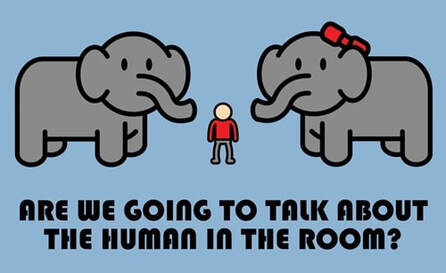 'Worthwhile elephants make it real.' ‘Of course.’ I can hear you thinking. ‘Tell us something we don’t already know.’ Or, perhaps – and quite reasonably so – you are wondering what on earth I am talking about. If, by chance, I have spiked your curiosity, let me break it down into 3 parts that form important ingredients of inspiring and effective conversations at work: worthwhile; elephants; make it real. It’s about a degree of focus and quality of contact that can release energy, engender engagement and achieve great results. First: worthwhile. ‘If we were to be having a really useful conversation, what would we be talking about?’ (Claire Pedrick). ‘What outcome from this conversation will mean our time together will have been well spent?’ Or, ‘First things first – begin with the end in mind.’ (Stephen Covey). The aim here is to clarify goals and aspirations, test implicit assumptions and co-create focus. It addresses the question: ‘Of all the things we could spend time doing together, what would make this valuable?’ Second: elephants. ‘The most valuable thing any of us can do is find a way to say the things that can’t be said.’ (Susan Scott). It’s about naming the proverbial elephants in the room or, in Gestalt, speaking the unspoken, saying the un-said. ‘What are we not talking about that, if we were to talk about it, would release fresh insight and energy in this conversation…and in this relationship too?’ This is an invitation to ‘radical candour’ (Kim Scott), to practise courage, disclosure and openness. Third: make it real. ‘What matters most to you in this?’ It’s about being real…doing real…avoiding an unhelpful, distracting dance around the most important questions and issues in the room. Cultural complexities surface here: how to hold conversations that are open and honest and, at the same time, respectful of different cultural nuances and norms. The core principle here is ‘challenge with support’ (Ian Day & John Blakey): having the conversations we need to have to move things forward. ‘Work-life balance’. What's that all about? Picture this: I have my work perched at one end of the see-saw that somehow represents my life and my…erm…my life perched precariously at the other. On the face of it, it signifies that my work is completely and utterly devoid of anything that comes close to life and, similarly, that my life is hermetically sealed off from work. I guess I could re-draw the image so that there’s a blurry, permeable bit between the two ends but, even so, it still depicts my work and my life as a polarity, distinctly different and at opposite ends of a spectrum.
OK, I’m being a bit playful here. I get the idea – to help ensure that we pay attention to different aspects of our lives, in particular to avoid work taking over our whole lives. There are echoes of biblical principles of Sabbath in this, safeguarding a space for spiritual, psychological, physical and social refreshment, enrichment and restoration. It poses important questions in modern day, post-modern life, especially against a backdrop of increasing mental and physical health costs of a non-stop lifestyle, e.g. how to do ‘Sabbath’ meaningfully in the midst of 24hr connectivity? Post script: Now here’s a weird thing. When I typed ‘work-life’ into my phone, it auto-corrected to ‘worm-like’. I know what you’re thinking: I really need to get out more – and you may well be right. But what occurs to me is that a worm lives most of its life inside a tunnel in total, relentless darkness. By contrast, there’s something for us here about how to discover and create light, freedom, meaning and purpose in whoever we are, in whatever we are doing. The question then is how to be alive in its widest, deepest, most holistic sense in all aspects of our lives - including in our work. How do we do it? When did you last have a great conversation at work? I’ve noticed that frustration and fatigue often arise from conversations and meetings that lack focus, that feel pointless, that lack purpose. It’s one of the main reasons why there is so much cynicism about meetings in organisations.
Now while different types of conversation are appropriate for different relationships and situations, questions that tease out purpose can be very powerful. They surface assumptions and create opportunity to discuss and agree on what would be worthwhile. Here are some purpose-focused questions: Why are we here? What are we here to do? What would make this time useful? What is the goal we’re trying to achieve? What would a great outcome look and feel like? What do we want to be different by the end of this conversation? We can use purpose-focused questions at the start of a meeting or mid-way through if we start to notice drift or confusion. ‘Let’s just remind ourselves what we’re here to do…where we’re trying to get to.’ Focusing and re-focusing can energise our conversations and achieve great results. When teams are under pressure, e.g. dealing with critical issues, sensitive topics or working to tight deadlines, tensions can emerge that lead to conversations getting stuck. Stuck-ness between two or more people most commonly occurs when at least one party’s underlying needs are not being met, or a goal that is important to them feels blocked.
The most obvious signs or stuck-ness are conversations that feel deadlocked, ping-pong back and forth without making progress or go round and round in circles. Both parties may state and restate their views or positions, wishing the other would really hear. If unresolved, responses may include anger/frustration (fight) or disengagement/withdrawal (flight). If such situations occur, a simple four step process can make a positive difference, releasing the stuck-ness to move things forward. It can feel hard to do in practice, however, if caught up in the drama and the tense feelings that ensue! I’ve found that jotting down questions as an aide memoire can help, especially if stuck-ness is a repeating pattern. 1. Observation. (‘What’s going on?’). This stage involves metaphorically (or literally) stepping back from the interaction to notice and comment non-judgementally on what’s happening. E.g. ‘We’re both stating our positions but seem a bit stuck’. ‘We seem to be talking at cross purposes.’ 2. Awareness. (‘What’s going on for me?’). This stage involves tuning into my own experience, owning and articulating it, without projecting onto the other person. E.g. ‘I feel frustrated’. ‘I’m starting to feel defensive.’ ‘I’m struggling to understand where you are coming from.’ ‘I’m feeling unheard.’ 3. Inquiry. (‘What’s going on for you?’). This stage involves inquiring of the other person in an open spirit, with a genuine, empathetic, desire to hear. E.g. ‘How are you feeling?’ ‘What are you wanting that you are not receiving?’ ‘What’s important to you in this?’ ‘What do you want me to hear?’ 4. Action. ('What will move us forward?’) This stage involves making requests or suggestions that will help move the conversation forward together. E.g. ‘This is where I would like to get to…’ ‘It would help me if you would be willing to…’. ‘What do you need from me?’ ‘How about if we try…’ Shifting the focus of a conversation from content to dynamics in this way can create opportunity to surface different felt priorities, perspectives or experiences that otherwise remain hidden. It can allow a breathing space, an opportunity to re-establish contact with each other. It can build understanding, develop trust and accelerate the process of achieving results.  It was an energising experience, facilitating a group of leaders this week who are keen to build a new high performing team. We pushed the boundaries of normal ways of working to stimulate innovative ideas in all aspects of the team’s work. We used photos to create an agenda and physically enacted people’s aspirations to avoid falling into conventional patterns of heady, rational conversation. It felt very different to meeting ‘because that’s what we do’. There was a different dynamic, energy and momentum. Participants leaned actively into the conversation, not leaning back in passivity or boredom. Yet it can be a real challenge to break free from tradition, from norms that trap a team in ways of doing things that feel familiar and safe but, deep down, lack inspiration or effectiveness. In our meetings, how often do we pause before diving into the agenda to ask, ‘What’s the most important thing we should be focusing on?’, ‘How are we feeling about this?’, ‘What is distracting us or holding our attention?’, ‘What could be the most creative and inspiring way to approach this?’, ‘What do we each need, here and now, to bring our best to this?’, ‘What would be a great result?’ So I presented a simple model to the team with four words: content (what), process (how) and relationship (who) encircled around goal (where). In all my experience of working with individuals and teams, whether in coaching, training or facilitation, whether in the UK or overseas, these four factors are key recurring themes that make a very real difference. They seem to be important factors that, if we get them right, make a positive impact. They lead to people feeling energised, more alive, more motivated and engaged. Conversely, if we get them wrong, they leave people frustrated, drained of energy, bored or disengaged. Worse still, if left unaddressed, they can lead to negative, destructive conflict that completely debilitates a team. We can use a simple appreciative inquiry to reflect on this.‘Think back to your best experience of working with another person or team. How did you feel at the time?’, ‘Think back to a specific example of when you felt like that with the person or team. Where were you at the time? What were you doing? What were they doing? What made the biggest positive difference for you?’ One of the things we notice when asking such questions is that different things motivate and energise different people. That is, of course, one of the tricky parts of leading any team. So a next question to pose could be something like, ‘What would it take for this team to feel more like that, more of the time for you?’ and to see what the wider team is willing to accommodate or negotiate. Now back to the model with some sample prompts to check out and navigate with a client, group or team. Notice how the different areas overlap and impact on each other. It’s about addressing all areas, not just to one or two in isolation. However, having explored each area in whatever way or level suits your situation, you are free to focus your efforts on those that need special attention. Goal: ‘What’s your vision for this?’, ‘Why this, why now?’, ‘What are you hoping for?’, ‘What would make a great outcome for you?’, ‘What would be the benefits of achieving it or the costs of not achieving it?’, ‘Who or what else is impacted by it and how?, ‘Where would you like to get to by the end of this conversation?’, ‘An hour from now, what would have made this worthwhile?’ Content: ‘What’s the most important issue to focus this time on?’, ‘What is the best use of our time together?’, ‘What is the issue from your perspective?’, ‘How clear are you about what this issue entails?’, ‘What feelings is this issue evoking for you?’, ‘What do we need to take into account as we work on this together?’, ‘Do we have the right information and expertise to do this?’ Process: ‘How would you like to do this?’, ‘What approach would you find most inspiring?’, ‘What might be the best way to approach this given the time available?’, ‘Which aspects to we need to address first before moving onto others?’, ‘What would be best to do now and what could be best done outside of this meeting?’, ‘Could we try a new way that would lift our energy levels?’ Relationship: ‘What’s important to you in this?’, ‘What underlying values does this touch on for you?’, ‘How are you impacted?’, ‘How are you feeling?’, ‘What are you noticing from your unique perspective?’, ‘What distinctive contribution could you bring?’, ‘What is working well in the team’s relationships?’, ‘What is creating tension?’, ‘How could we resolve conflicting differences?’ The versatility of the model is that it can be reapplied to coaching, training and other contexts too. In a training environment you could consider, for instance, ‘What are we here to learn?’ (goal), ‘What material should we cover?’ (content), ‘What methods will suit different learning styles?’ (process) and ‘How can we help people work together well in this environment?' (relationship). In a coaching context it could look something like, ‘How do you hope to develop through engaging in this coaching experience?’ (goal), ‘What issues, challenges or opportunities would you like to focus on?’ (content), ‘How would you like to approach this together?’ (process) and ‘What would build and sustain trust as we work on these things together?’ (relationship). I’d be interested to hear from you. Do the areas represented in this model resonate with your own experiences? Which factors have you noticed tend to be most attended to or ignored? Do you have any real-life, practical examples of how you have addressed these factors and what happened as a result? In your experience, what other factors make the biggest difference?  What is real, what is true, how can we know? These are questions that have vexed philosophers for centuries. In more recent times, we have seen an increasing convergence between philosophy and psychology in fields such as social constructionism and existential therapy. How we experience and make sense of being, meaning and purpose is inextricably linked to how we behave, what we choose and what stance we take in the world. As a Christian and psychological coach, I’m intrigued by how these fundamental issues, perspectives and actions intertwine with my beliefs, spirituality and practice. Descartes once wrote, ‘If you would be a real seeker after truth, you must at least once in your life doubt, as far as possible, all things.’ It’s as if we must be prepared to suspend all assumptions about ‘what is’, to explore all possibilities and dare to think the unthinkable in order to grow and make our best contribution. Things are not always as they at first appear. There are sometimes multiple explanations for the same phenomenon, depending on the frame of reference we or others use to interpret it (see, for instance, Gareth Morgan’s seminal work, Images of Organisation, 1986). We are sometimes blinded to what’s in front of us by our prejudices, preconceptions, cultural constraints or rigid views of the world. It can be hard to maintain healthy scepticism without cynicism. I see it with clients, sometimes in myself too. A sense of being trapped by a fixed Gestalt, a cognitive distortion, an inherited or learned belief system. An inability to see, to recognise the box that we’re in, never mind to see or think outside of it. An avoidance of deep, difficult questions because of the discomfort, confusion or anxiety they may evoke. If we’re not careful, if we can’t find the right help when we need it, it may limit our lives and our learning. I think this is where coaching can play a very important role, helping pose and address some deep questions. Nick Bolton commented insightfully in Coaching Today that, ‘To explore a coaching issue existentially is to understand the relationship that the presenting problem has to the human condition to which it is a response, and to remain focused on enabling a change of perspective that allows the client to move past their current challenge.’ He also provided some helpful examples: ‘For instance, how is a client’s procrastination around something that seems to matter to her a failure to remember that life comes to an end? How is a client’s need to be unconditionally loved by his partner an attempt to deal with existential rather than interpersonal isolation? (And the solutions are very different things). How is someone’s lethargy simply a part of their fear of taking responsibility for their life?’ (July 2013, p17) A metaphysical, existential or theological dimension can shift the entire paradigm of the coaching conversation. The question of whether a client should apply for this or that job is influenced by her sense of purpose. If she is willing to consider that God may exist and have a plan for her life, the whole situational context will change. It can be a dizzying and exciting experience, yet it’s really a question of how courageous and radical we and the client are prepared to be. I had precautionary tests this week for a potentially life-threatening condition. Thankfully, the results turned out to be OK but it’s experiences like this that often bring existential issues into sharp relief. Existential coaching focuses on helping a person explore his or her own sense of ‘being in the world’, that strange psychic awareness that we are in the world before what we are in the world. At times, such awareness can feel mysterious, unfathomable, disorientating and anxiety-provoking. It’s like one of those moments when, as a child, I gazed up into the night sky, saw the stars and the enormity of space, imagined space and time going on forever and felt dizzy and perplexed by it. It can also raise deep questions to the surface such as, ‘Who am I?’ and 'Why am I here?’
According to existentialist thought, our essence as a person isn’t fixed but we become who we are through the choices we make. Our choices are influenced by factors such as the assumptions, beliefs, judgements, hopes and fears etc. we hold about ourselves, the same we hold about others and how we experience and act in our relationships with others, in our everyday circumstances and in the decisions we face and make. Existentialist writers sometimes refer to this as our ‘stance in the world’, that is, how we perceive, position ourselves and act in our everyday lives. Our stance both reflects something of our sense of and our way of being in the world and shapes who we are and become in the world. I can share a personal example to illustrate this phenomenon. When my youngest daughter was 7 years old, I took her to a theme park that had a very high and steep ‘death slide’. I was surprised and impressed to see her quietly but resolutely psyche herself up to leap down its harrowing slope. When she finally did do it, I asked her how she managed to bring herself to push herself off its terrifying edge. She responded in a way that humbled and amazed me: ‘Firstly, when you told me it would be OK, I trusted you that it would be OK, even though it looked so scary. Secondly, when I write about what we did today in my diary tonight, I want to be able to write that I went on the slide even though I was afraid of it, not that I didn’t go on the slide because I was afraid of it. That’s the kind of person I want to be.’ I felt awe-struck and speechless. Curiously, we are often unaware of making choices, or deny to ourselves that we are making choices in order to avoid the responsibility that choice implies, and unaware of the underlying metaphysical world view we hold that both influences and is influenced by our choices. It’s as if we can live at a superficial level, sometimes choose to live at that level as a form of self defence or life-coping mechanism. The problem is that if we only live at that level, we may fail to be who we can become in the world; deny ourselves and others a deeper and more fulfilling life experience; struggle with contact in intimate relationships; expend our time, energy and resources on distractions that aim to suppress or avoid facing the discomfort and anxiety that existential issues can evoke. One of the goals of existential coaching is therefore to raise world view and choice into awareness in order enable clients to live more authentic lives. It’s about enabling clients to acknowledge and deal with underlying anxiety, tensions and conflicts that could be experienced symptomatically in psychological, emotional, physical or relational difficulties or in problematic patterns of behaviour. Duerzen summarises this approach in Skills in Existential Counselling and Psychotherapy (2011) as, ‘to help people to get better at facing up to difficulties with courage instead of running away from them’. It necessarily involves a willingness to explore issues beneath the surface, a willingness to face anxiety and a willingness to explore alternative ways of being and acting in the world. This reminds me of a volunteer assignment I did with a Christian social worker and psychologist in Germany not long after the Berlin wall came down and East and West were reunified. We were working in a social work project with young people, often from fairly poor and dysfunctional family backgrounds, who were being seduced by the far right to join new neo-Nazi groups. The groups provided these young people with a much-needed sense of identity, belonging and purpose in the world. As part of his practice, the social worker would touch sensitively on spiritual issues and questions where it seemed appropriate. A secular humanistic colleague challenged him vehemently on this, insisting that social workers should never stray into the spirituality arena. The social worker empathised with his colleague’s concerns about professional ethics and the risks of pressurising and indoctrinating vulnerable young people. At the same time, he believed that true spirituality speaks to life’s deepest questions, experiences and actions. The social worker responded, ‘These young people often talk in therapy about their deepest fears, about life and death, issues that are very real for them. It’s often such fears that lead them to seek a sense of identity, security and purpose in these sinister groups. We cannot afford to separate our thinking or our practice into neat, distinct, spheres of influence. The matters we and they are dealing with bring profound psychosocial, existential and spiritual issues face to face in the room.’ I agree. So what could existential coaching look like in practice? Firstly, the coach will invite the client to share their story, particularly focusing on issues that led them to work with a coach in the first place. The coach’s role at this stage is primarily to listen and, over time, to reflect back any beliefs and values that surface implicitly or explicitly in the client’s account, particularly in terms of how the client perceives themselves, others, issues and their situation. In this sense, the coach is acting as a sounding board and a mirror, enabling the client to grow in awareness of his or own world view. The coach will go on to focus on specific tensions that may emerge, e.g. between the client’s underlying beliefs and values and the stances or actions they are choosing in practice. The intention here is to surface the client’s underlying personal and cultural metaphysic rather than simply his or her way of perceiving and responding to an immediate issue. This approach is based on a belief that the client’s general world view or stance-in-the-world will influence e.g. what issues the client perceives as significant; how they perceive, experience and evaluate them; what their subjective needs and aspirations are; what approaches and actions they will consider valid or appropriate; what actions they will be prepared to commit to and sustain etc. This approach also enables the client to explore any tensions within their world view, between that world view and those of others in their situation and between their world view and their actions. The problem with the language of ‘world view’ in describing such an approach is that that it sounds too conscious, too cognitive, too coherent. The focus of existential coaching is profoundly subjective and phenomenological, that is, how the client actually experiences and responds to his or her being-in-the-world at the deepest psychological levels. In that sense, it’s as much about how a person feels, the questions they struggle with and what they sense intuitively as what they may think or believe rationally. Again, there are important links for me with a spiritual dimension. As I faced my own health-related tests this week, for instance, I experienced my faith in God as something more like a subconscious, mysterious, inner ‘knowing’ than a rational assent to a set of beliefs. As the coaching conversation progresses, the coach may help the client identify choices he or she is making (including by default), potential choices he or she could take in the future and how to integrate the client’s choices with his or her chosen being and stance in the world in order to live a more authentic and thereby less conflicted life. At one level, this enables the client to become more aware of and honest about their decisions and actions and to act with a greater sense of freedom and responsibility. At another level, it opens up more opportunities for the future than the client may have perceived previously. It can feel very liberating and energising to discover fresh ways of perceiving and acting in situations that have previously felt stuck or entrapping. Sample coaching methods could involve helping the client reframe experiences as choices or to change their language from passive to active voice. For example, ‘I have to write this report for my boss by Friday’ or ‘This report needs to be written by Friday’ sound and feel less empowering than, ‘I will choose to write this report for my boss by Friday’. It enables the client to take ownership of their choices and to weigh up alternative courses of action. After all, if it’s a choice, I can choose differently, although I will need to weigh up the relative pros and cons of different choices. My best choices are congruent with my underlying beliefs and values, e.g. in this case, respect for authority, the sense of a job well done or a desire to keep my job so I can pay my bills. The coach is likely to help the client connect their choices with their underlying world view. One way to approach this is to use the ‘7 whys’ technique whereby each time the client explains why they are choosing a certain course of action, the coach responds with, ‘…and why is that important to you?’ until the client’s deepest values, aspirations and anxieties surface. I will end this piece by posing some brief existential questions for personal reflection: Who am I? What personal stance do I want to take in the world? How do I handle contradiction, ambiguity, uncertainty and paradox? What is most important to me? What is God or this situation calling for from me? How consistent are my choices with my values? How well do my actions reflect the person I aspire to be? What’s your theory of change? What issues are you trying to address? What creates and sustains those issues? What kind of interventions and when are most likely to prove successful? What would success look and feel like, and for whom? What is your overall goal? These are some of the questions we looked at on a Theory of Change workshop I took part in yesterday. Theories of change are becoming increasingly commonplace in the third sector, paralleling e.g. strategy maps in other sectors. There are a number of reasons for this. Charities and NGOs are under increasing scrutiny from supporters and funders to demonstrate how their resources are being used to achieve optimal impact. This has created a whole industry in impact evaluation.
The third sector is maturing too. No longer driven into action by empathy or altruistic instinct alone, organisations in this sector have more experience, more evidence of what works and what doesn’t and more analysis and understanding of why. The issues have turned out to be more complex than some had originally imagined, making significant and sustained progress challenging. Against this backdrop, a theory of change can prove valuable. It aims to clarify goals and outcomes and to work back to activities and other factors that will enable the outcomes to be achieved. In articulating these things clearly and succinctly (often in simple graphic flowchart form), underlying assumptions and causal links can be surfaced, explained and tested. At heart, a theory of change answers questions such as ‘What are we trying to achieve?’, ‘What is necessary for the goal to be achieved?’ and ‘What’s the rationale behind our intervention strategy?’ In doing so, it makes the organisation’s focus, operations and use of resources transparent, accountable and more open to challenge and improvement as new research and evidence emerges. I find myself particularly drawn to the critical-reflective aspects. For instance, one NGO I worked with conducted a fundamental strategy review starting with these same principles, asking questions such as, ‘Why are people poor?, ‘What causes and sustains poverty?’, ‘What interventions make the greatest difference?’, ‘What is our optimal contribution?’ One of the interesting challenges for a third sector organisation is whose voice is represented in framing and answering such questions, e.g. donors, beneficiaries, trustees, staff, volunteers. A charitable organisation I work with currently conducted a strategy review recently, inviting feedback from beneficiaries using surveys, focus groups etc. to find out what they struggle with and aspire to and what role they would want to see the organisation playing in helping them address or achieve these issues. The needs and aspirations that surfaced have been summarised as ‘I’ rather than ‘we’ or ‘they’ statements in clear and colloquial language, keeping the focus on what each individual as beneficiary wants to experience as a result of the organisation’s actions. This is a sharp contrast with some experiences I’ve had in the past. In one instance, a third sector organisation I worked with set up a drop-in project providing advice and support for long-term unemployed people. The Local Authority provided funding using ‘number of people using the service’ as its key success criterion. Paradoxically, the more successful the service was in enabling local people to find employment, thereby reducing the number of people who needed to access the service, the more the service was deemed statistically by the Local Authority to be failing. A theory of change can help surface such outcomes and assumptions at an early stage, enabling more constructive dialogue and agreement between agencies and stakeholders. I believe the potential for theory of change extends beyond third sector organisations aiming to articulate their vision, strategy, plans and reasons behind them. I’ve used similar methodologies to explore and articulate an organisation development strategy within a third sector organisation. We started by exploring a number of questions with diverse stakeholders and groups such as, ‘What kind of organisation are we trying to develop?’, ‘Where are we now?’, ‘Why are things as they are?’, ‘What drives or sustains how things are?’, ‘What matters most to people here?’, ‘Who or what influences change?’, ‘What would it take to achieve the changes?’ This enabled us to create a map showing goals, activities, assumptions and causal relationships. The same principles can be applied at team and individual levels too, e.g. for leadership, coaching, mentoring, training and counselling purposes. It enables dialogue between different parties and keeps rationale and assumptions explicit. If assumptions are clear to all parties, they can be challenged and revised in light of different preferences, perspectives, realities and evidence. I’ve used adaptations of this approach with people and organisations where Christian beliefs have been held as important and integral, developing the model as a theology of change. A theology of change may surface and articulate e.g. God’s purpose, values, presence and activity in the world, the role of the Spirit and Christians, discerning a sense of ‘calling’. In my experience, the language and methods of applying theory or change need to be adapted for different purposes and audiences. It represents a logical-rational paradigm that is likely to work well for some people and cultures but not so well for others. Using Honey & Mumford’s learning styles as one possible frame of reference, theory of change (as the name implies) may appeal most to people, teams or cultures with a theorist orientation. Reflectors may be attracted most by its emphasis on surfacing underlying assumptions, activists by the evidential dimensions and pragmatists by its focus on outcomes. Perhaps the key lies in using the principles it embodies flexibly and sensitively in the context of real human dialogue and relationship. |
Nick WrightI'm a psychological coach, trainer and OD consultant. Curious to discover how can I help you? Get in touch! 
Like what you read? Simply enter your email address below to receive regular blog updates!


|
 RSS Feed