 ‘The international arms trade is in direct opposition to efforts to protect and pursue the health of our world and its inhabitants.’ (MedAct) When Jesus Christ was born, if he had been given the projected world armaments spend for this year alone – I have to sit down as I write this: he could have spent US$ 2,708,578 every… single… day... from then until now. And, whilst on the topic of Jesus, a good friend has a satirical sticker across the rear windscreen of her campervan that reads, ‘Who would Jesus bomb?’ The simple answer is, ‘Nobody’. He was far too concerned with bringing good news to the poor, vulnerable and oppressed. Bottom line: weapons didn’t feature on his bottom line. Yet here today we see world leaders striding confidently onto stages, adorned with flags and symbols, making elegant speeches and pointing accusing fingers at one another across starkly-divided world maps. Everyone is firmly committed to the, ‘I’m OK, You’re Not OK’ creed and absolutely convinced by the rightness of their own cause. The platform rhetoric is powerful, existential, and ramps up the ante. It’s a dangerous zero-sum, do-or-die game in which we could all – quite literally – obliterate the world in a quest to, allegedly, save the world. Meanwhile, I see children in the Philippines this week who live in dire poverty, sleeping in rags on hard ground. There are countless millions across the world living like this, with barely enough to survive let alone thrive. Scraps of food and no access to safe water, sanitation, healthcare or education. US$ 2,708,578. So, Jesus again – ‘Reach out to your enemies.’ We could try this: ‘We’ve all made a real mess of this. We’re partly to blame and we’re sorry for the part we played in how we got here. We want to work with you to co-create a very different future.' Everything is at stake.
36 Comments
What do you really believe? It’s sometimes hard to know. We can believe something absolutely, with real passion and conviction, and yet act completely differently. The really weird thing is that we can convince ourselves that we’re living consistently with what we believe and yet the behavioural evidence, the decisions we take, the time and energy and resources we spend on people and things, can tell a very different story. Our human ability to deceive ourselves is quite remarkable.
Against this backdrop, words like integrity, genuineness, authenticity and congruence spring to mind as a stark contrast, posing a powerful and deep challenge to who we are and how we conduct ourselves in the world. We tend to think of these words as inner qualities, personal attributes, the idea of someone walking their personal talk whether anyone notices it or not. Yet they are often formed, outworked and sustained in the context of complex situations and relationships. In this sense, we could consider the integrity phenomenon as having social and cultural as well as personal dimensions. It’s about the individual but it’s not only about the individual. So we can ask: Who best models integrity for us? If we live seek to live with integrity in all aspects of our lives, what impact and influence does that have on those around us? What cultural beliefs and values nurture and support it? What social conditions provoke and inspire it, often against all the odds? What does this mean for leaders, OD and coaches? Here are some ideas: 1. Clarify our beliefs and values: what matters most to us? 2. Invite people to support and challenge us when we risk dissonance, self-deception or slip up on route. 3. Model, inspire, support and affirm integrity in behaviour, relationships, decision-making and culture. 4. Support and challenge, not collude, when working with clients. 5. Love, honour –and forgive – when we and others get it wrong. It’s Christmas Day and I could have better used the title Christmas mess-edge for this short piece. The story of Jesus Christ isn’t just a sweet and sentimental account of a baby boy born in Bethlehem 2000+ years ago. If it’s true, it’s about God entering the very real messiness of our lives and world and offering the potential to transform them into something completely new. Something beyond our wildest dreams, hopes or expectations. Something that stretches and transcends the boundaries of all human existence and experience.
I’ve known something about this notion of stretching boundaries over this past year, about extending the edges of my own experience. I bought a new bike in the spring, challenged myself to cycle over 1000 miles in 6 months and over 50 miles in a single ride. I had never done anything like that before and yet I did it. I also challenged myself to swim 1 mile 3 times in the same week. And I did it. It felt like I had crossed over an important physical and psychological line, achieving things that had previously felt impossible for me. I wrote and had published my first article with the British Association for Counselling and Psychology (BACP). I’d written lots of articles for different publications before but this felt like the next step up in a professional field that sits close to my heart. The editor of Coaching Today invited me to write on spirituality and I jumped at the chance. To top it off, I did my first ever series of radio interviews on spirituality too. It was a great opportunity and a novel experience so sit in a recording studio and to share my beliefs openly on air. And if that was the end of the story, there would be no need for a Jesus, at least for me. But it’s far from the end. I’ve struggled and failed on so many fronts. Sometimes, I haven’t even struggled when I have known I should. I’ve known deeply and personally what Francis Spufford aptly calls the universal ‘human propensity to f* things up’ (Unapologetic, 2013). At times, I’ve failed in relationships, made mistakes at work, fallen short of my own standards, spoken when I should have kept quiet and kept quiet when I should have spoken. What’s more, one of my closest friends has fought courageously with terminal illness. I’ve felt hopeful and helpless, trying to offer support where I could yet knowing I can’t make it OK. I’ve yearned to take the anxiety away but known that I can’t. I’ve watched Syria in the news, the damage that human beings are able to inflict on each others’ lives, on whole countries and regions. I’ve felt impotent and confused. Not all the time, but enough to know that redeeming the world is something I can take part in yet, ultimately, lies well beyond me. And so as I reflect on Christmas, I know what it is to be an aspiring yet fragile human being. I’ve felt exciting moments on the edge of success and have known what it is to screw up and need forgiveness. I have felt the amazing love of others, often undeserved yet tangible all the same. At that first nativity, I believe God himself entered the messy complexity of our lives and world with the most profound message of love and hope possible. Not just in words but in a life well-lived and a promise of presence and eternal life. Merry Christ-mas! 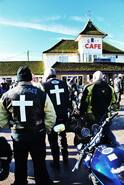 The first thing I notice is the random cluster of bikes parked outside the café ranging from Japanese street machines to British and American cruisers. I wander inside and get myself a hot mug of tea. There are no formal welcomes, only various bikers in black leathers and motorcycle gear sitting in small groups, talking earnestly or laughing as they chat together. The leader walks in. He has long hair, a wispy beard and piercing blue eyes. This man, Graham, has an unusual warmth in his smile as he glances around, beckoning informally to whoever is interested to join him in the room next door. We get up and slowly wander in across the cold hallway. The seats, like their occupants, are covered in black leather. It’s chilly inside and there’s a single oil-filled heater in the corner. The conversation starts easily, people speaking in relaxed tones as they talk about the ride in, things that have been happening at work in the past week, ordinary things, everyday things. There is no ecclesiastical language, no religious jargon, no speaking in stuffy tones. It feels natural, real. I wonder what’s going to happen next, curious about this earthy bunch of heaven’s angels. This was my first encounter with a Christian Motorcyclists’ Association (CMA) meeting, a loose organisation of ordinary blokes who share two passions: bikes and Jesus. One person talks about how much he struggles to get his head around anything to do with God at the moment, feels very messed up like everything is going wrong in his life. Others around the room nod and empathise. He looks reassured. Another talks excitedly about his return to faith after years in the drugs and clubs scene. He is energetic and animated as he speaks and his enthusiasm is infectious. Another looks thoughtful and talks about how, when he’s working on his bike, he gets totally focused on it. He goes on to comment how easy it is to get preoccupied with things, whether good or bad. The conversation, like the bikes outside, feels random but a strange flow emerges. The bloke next to me chips in, ‘If we focus on something long enough, act on it consistently enough, we become defined by it.’ The bloke next to him agrees and says ‘Yes, like anger. If we allow someone to anger us, they control us.’ Another says, ‘Yes, and if you are always angry, it becomes who you are.’ The room falls silent. One by one, these men start to share stories about when they’ve been angry, when someone has really wound them up, treated them unfairly, different things they’ve tried to deal with it. It gets quite heated at points and Graham chips in with Jesus’ teaching and example of forgiveness, how meaningful it is, how healing it can be. It felt unforced, timely, but I wonder how the others will react. They start mulling over this, how difficult it can be, what it feels like when they manage it even if only for a short time. You can tell these blokes want to get it right, want to follow Jesus’ example, and they're instinctively determined not to gloss over realities. They close by praying out loud, whoever wants to, speaking on behalf of the group. ‘God, help us because we can’t do this stuff on our own.’ The meeting closes and we stroll back into the café. The whole thing has lasted just 30 mins. I feel immediately inspired and challenged by what I’ve just seen, heard, felt, being part of. I don’t own a bike (although I've owned 21 and crashed 19) but these guys accept me, a stranger. As we chat and laugh over bacon and egg, they are the same in the café as they were in the room. No facades, no pretence. They’re happy to get their hands dirty and their faith is very practical too, looking out for each other, providing pastoral care at biker events, running charitable activities, praying for people who need support. We exit the café, the bikes rumble off with a snarling roar…and I’m left with the distinct impression I’ve been in the presence of Jesus. (www.bike.org.uk/cma) I took part in an excellent mediation workshop this week run by Karen Bailey, a talented and experienced coach, mediator and trainer in this field (http://www.karenbaileymediation.com/).
I found it interesting to explore different models and approaches ranging from arbitration and advocacy through to non-directive facilitation. It resonated for me professionally because, as an OD practitioner, I’m often invited to coach others on conflict resolution, to do teambuilding where unresolved conflict is a factor affecting team morale and performance, or to act as a third party helping others (e.g. line managers and staff, or peers) to address and resolve stuck-ness or tensions between them. It also resonates for me spiritually because the notion of mediation is at the heart of my Christian beliefs. The biblical characterisation of Jesus Christ as mediator between God and humanity is the cornerstone of Christian theology, a role that Christians too are called to emulate and follow as peace-builders in the world. The model we explored and practised emphasised the importance of creating a semi-structured space for parties to listen to each other. If they can genuinely hear each other, there is scope for establishing empathy and reaching shared solutions. This involves the willingness of all parties to engage in open, direct and…potentially scary…dialogue. The mediator speaks to this fear dynamic explicitly: ‘This is going to feel very uncomfortable, but we’re here because we believe the outcome will be worth it.’ If the mediator and participants can learn to manage their own anxiety by facing it head on, they may also feel able to lower their defences and hear each other. We looked at four conditions that enable this type of mediation to be successful: the mediator is impartial; the mediation is confidential; participation is voluntary; outcomes are self-determined. These condidtions provide a basis for establishing clarity and for contracting with oneself, participants and sponsors beforehand. Karen explains why these same conditions can sometimes make it difficult for internal HR (or OD) practitioners to fulfil this role within their own organisation or business partnering arena effectively. (For further comment on this issue, see: http://www.karenbaileymediation.com/transforming-hr-practitioners-into-mediators/). We also looked at four aspects of participant experience and perspective that provide a content-orientated focus for the mediation: each participant’s Story; each participant’s felt Impacts; each participant’s Needs; each participant’s Goals (making the acronym SING). The mediator meets with each participant to tease out these aspects beforehand. The participant’s story is his or her own subjective experience of the situation; impacts are what he/she is feeling emotionally; needs are unfulfilled desires or challenged values; goals are the outcomes each person hopes for. ‘What’s going on for me’, ‘How this is impacting me’ and ‘Why this is important to me’. At the start of the session with all parties in the room, the mediator reiterates the process and invites the participants to (a) be honest and direct with each other and (b) listen and show respect to each other. The mediator may invite each party to make an opening statement and then allow the conversation to free-flow. The tricky part I found as mediator-in-practice was when to intervene and not to intervene, how to intervene in such a way that facilitates rather than interferes with the process, how to manage my own anxieties if ferocious conflict emerges, if one party appears bullied or if the conflict became directed at me. Karen offered some useful ideas…simple in principle, harder to do in practice! The mediator can summarise, reflect back…’This is what I’m hearing…’, ‘Sounds like…’, enabling the participants to feel heard before moving on. The mediator can call for a break, allowing mediator and participants to step back, take time out if they need to cool down or reflect before re-engaging. The mediator can co-facilitate with another mediator, creating the benefit of two perspectives, insights and interventions, especially valuable if one of the mediators feels hooked, emotionally destabilised or disorientated by something in the conversation and needs to detach in order to re-engage. The real challenge, opportunity and skill lies in enabling the participants to establish and maintain high quality contact with each other, even if that contact feels loaded with intense emotion. It’s a process that involves faith, faith that if the participants will find a way to hear and connect with each other, that they may feel empathy and will move towards finding their own solutions. It also demands that the mediator be fully present in the room, fully in role and fully in contact with participants. The session ends with participants discussing and agreeing their own way forward. This kind of mediation clearly demands patience and courage but the benefits can be transformative. I was speaking with a colleague recently who felt trapped in unresolved conflict. It was a key relationship, one that couldn’t be avoided, and all previous efforts had failed. As a consequence, both parties were feeling frustrated, de-energised and despondent about the future. As we explored how they had attempted to fix things in the past, it became clear they had focused on all the negatives…a long list of annoying and painful experiences from the past. Their conversations were characterised by blame and demands. It felt intractable.
The problem with such patterns of behaviour is that they create a negative expectation of the future. Both parties now felt stressed before they even spoke with each other. The stress affected their perspective and their resilience, their ability to hear and to cope. So we decided to try a different approach. How to build a positive expectation in order to create a different focus, a different conversation and, ultimately, a different relationship. It wouldn’t be easy but it felt worth a go. My colleague felt sceptical but, nevertheless, willing to give it a try. Firstly, we agreed that next time they spoke, they would meet off site in a physical environment (e.g. café, park) that they both found positively stimulating and energising. This helped to break them away from the current environment that held such negative memories for them. Secondly, we agreed they would speak only of the positive moments in their relationship together. They found this hard at first. The negative experiences felt so overwhelming that they could hardly think of any positives. Nevertheless, they managed to remember some examples. Thirdly, we agreed that after sharing such positive examples, they would each share future hopes for their relationship: ‘what we would like our relationship to be more like, more of the time’. They reflected each others’ hopes back to each other: ‘So you would like…’ Fourthly, we agreed they would move on to discuss ‘what it would take from me to make this work in practice’. This shifted each party’s focus from the other onto themselves. ‘This is how I would need to change…this is what it will take for me to do it…this is the help I will need.’ This kind of approach demands openness to fresh possibilities, humility, a willingness to forgive. It demands imagination and courage too, an ability to envision and embrace a new future. It’s not easy and the support of a friend, counsellor or coach can help make the journey possible. I would be interested to hear examples from others who’ve worked on conflict resolution too. What was the issue? How did you approach it? What happened as a result? What made the biggest difference? What did you learn? What would you do the same or differently next time? The hand gripped my shoulder and I felt my blood freeze. I had been caught red-handed, stealing from a supermarket with two friends. Even though this incident was nearly 40 years ago, it still makes me shudder to recall it. The police were called and so were my parents. It was a frightening, humiliating, embarrassing experience. How could we have been so stupid? How would my family and other friends react? What would happen now?
The police released me and we drove home in painful, stony silence. I didn’t feel guilty, I just felt trapped, helpless to escape. I had made a big mistake and felt utterly powerless to change it, or to influence the consequences. The weeks passed and eventually I received a letter to appear before the local police superintendent. By now I did feel worried. Would I be sent down, sent to a youth detention centre? The thought filled me with horror. The police chief sat behind his desk and looked at me thoughtfully, kindly. He explained in a calm, compassionate and warm voice that although I had done wrong, to take strong action would destroy my life and future. In light of this, he explained, no further action would be taken. I was being given a second chance. I couldn’t believe it. I felt surprised, confused, grateful, immensely relieved. A huge and terrifying weight had been lifted. As we drove home, I began to feel remorse. A total stranger, the wronged party, had chosen to let me off the hook, to set me free. I deserved blame, punishment, and yet they had chosen to forgive me. I couldn’t understand it. They didn’t forgive me because I was good, but because they were good. They saw the potential in my life, the offender, and chose to release it. They gave me a new life. It was undeserved grace, an incredible gift. This experience impacted me deeply. Years later, I encountered that same attitude in God when I was introduced to Jesus Christ. I had believed in God, at least at some level, all of my life but this was something completely different. It was a profound existential experience, a explosive encounter that changed the focus and course of the rest of my life. God had used that police encounter, the power of forgiveness, to reach into my psyche and touch me. And so I pray that God will make me more like that. How easily I can get annoyed by the little things. A person cuts me up in traffic, drives using a mobile phone, stays in the middle lane of a motorway. A neighbour leaves a dog out barking at night or plays their TV too loud. A colleague does something that frustrates my plans or fails to meet my standards. How easy it is to get critical and judgemental. ‘Forgive us, Lord, as we forgive others too.’ I couldn’t decide whether to laugh or cry. I was looking for a speaker on Christian leadership recently and a colleague recommended someone from the House of Lords. I contacted this person by email and got a reply that simply said, “In any future communications, kindly address your correspondence to Lord X, not Mr X.”
Excuse me? It took self-restraint not to reply with something like, “Anyone so concerned with title and status is certainly not the speaker we’re looking for!” After all, the Bible has a lot to say about leadership, with words like humility and servant spirit featuring as headlines. Jesus, Son of God, demonstrated it in his own life and practice. But I noticed on reflection how easy it is to judge. The email response felt like a slap, an arrogant condescension. It touched on my raw political sensibilities, wounded my own pride, evoked a sarcastic, confrontational spirit within me. Yet am I really so different? Jesus didn’t only preach humility. He preached love and forgiveness too. Serbia, sabre, cold steel. The word still strikes a cold chill. It’s not the country, the people. It’s the symbolic idea, the ultranationalist vision, the das Reich of the Balkans. It’s the pernicious ideology that drove a nation to commit unspeakable crimes.
It’s the Bosnian girl I spoke with, cried with, whose father was murdered by a vicious Serbian militia, whose best friend was shot dead by a Serbian sniper in front of her eyes, a young girl, shot in the leg and had to crawl away to save her own life. It’s the refugees I saw in Albania, pouring over the border from Kosova, filled with terror as the Serbian troops advanced. It’s the smirking Serbian soldiers on the TV screen, arrogant, powerful and heartless in their pursuit of a ‘greater Serbia’, an ‘ethnically cleansed’ land. Mladic. I was delighted to hear of his arrest this week. It was the same delight when I heard of Karadzic’s arrest. The same delight when I saw NATO aircraft pounding Serbian military positions – too late, but at last. It was an intense feeling of relief, payback, hope. Mladic. I know the face but I don’t know the man. Mladic the icon, the human face of heartless murder. The leader, the decision-maker, the perpetrator, the personification of evil. I feel anger, despising, an urgent desire that he should suffer and face justice. Then God turned the spotlight to own spirit, my hard-heartedness towards a fellow human being, my self-righteousness in the face of another’s deep failings, the unforgiving projection of my own sin, my joy in the face of another’s anguish, this baying desire for revenge. And I’m reminded of the call to forgive, to remember forgiveness, to plead for God’s help to forgive, to see the person beyond the projection, to show mercy where he has shown none, hard as it is - to trust in God’s redeeming justice and grace. I’m reminded to learn to love. |
Nick WrightI'm a psychological coach, trainer and OD consultant. Curious to discover how can I help you? Get in touch! 
Like what you read? Simply enter your email address below to receive regular blog updates!


|
 RSS Feed