 ‘If I had only one hour to save the world, I would spend fifty-five minutes defining the problem, and only five minutes finding the solution.’ (Albert Einstein) Action Learning is a powerful way to explore an issue, formulate a solution and enable personal agency to act and influence change. It can also be used effectively to enable a group with shared interests or concerns to work on and address an issue together. The first step in this latter approach often entails helping a group to formulate its own question or hypothesis at the outset, a bit like when conducting action research, to establish appropriate focus and boundaries. As a facilitator, we can invite the group to reflect on criteria and wider considerations as it performs this initial task. Here are some examples: a. In relation to this issue, who are they key stakeholders in the system? b. Do we have the right people in the room to address this issue? c. Is it feasible to make useful progress on the issue in the time we have available? d. Are there any ethical, intersectional, reflexive or relational issues we should pay attention to in how we do this? Sometimes, I notice that one or more participants may have an intuitive awareness, a feeling or a hunch that something is, say, anxiety-provoking, challenging or stuck in their system, yet they may struggle to articulate it. In that case, I may invite them to, for instance, draw a picture, tell a story or enact a stance to help surface whatever issues lay beneath for them. Then, we continue the process (above) to reach clarity and agreement, as a group, before we move forward.
10 Comments
 ‘I know that I know nothing.’ (Socrates) Action Learning is an opportunity to receive questions. It’s founder, Reg Revans, advocated: ‘Swap your difficulties, not your cleverness.’ Revans’ approach was a radically different philosophy and praxis that stood in contrast to conventional didactic methods at the time. It affirms the value of not-knowing, curiosity and exploration. It facilitates a grappling with questions that have no easy answers and creating experimental solutions; without a pressure to hide from or impress peers. A transformational dimension of Action Learning is the power of vulnerability in building trust. If I model an authentic openness, a willingness to share those issues and experiences that I find most perplexing or troubling in my own work, it may invite others, in Susan Scott’s words, to ‘come out from behind (themselves) and make it real’ too – if they choose it. Stephen Covey expresses this dynamic well in his insight that, ‘Trust grows when we take a risk and find ourselves supported.’ I like the questions that Angie Bamgbose poses to herself in her insightful Action Learning blog, Race, Power and Privilege: ‘What is my gift? What am I still confused about? What have I learned? What will I do?’ It models the spirit of courage, humility and reflexivity that lays at the heart of Action Learning practice. It reminded me of guru Rick James’ opening words at an INTRAC webinar this year, looking at the future of humanitarian work internationally: ‘There is so much I don’t understand’. How do you use questions to stimulate reflection, insight and action? How do you handle personal and cultural pressures to present a front, to impress or to ‘perform’? (See also: Not-Knowing; Managing our Not-Knowing; Action Learning)  ‘You can lead a horse to water, but you cannot make it think.’ (Mark Lawson, Twisted Idioms)
My mind, heart and soul have been turned upside down, inside out. I’ve had the privilege and, at times, intense discomfort of being mentored by a Chinese coach and Christian pastor. I half-jokingly call her Why, rather than her real name Wei, because of her courage and tenacity in pressing deeper, innocently, with the next question. My usual subconscious ways of getting myself off the hook have failed miserably. My beliefs, values and behaviour have all been thrown into question. Wei’s natural orientation towards critical reflexivity means she examines her own attitudes and behaviour transparently – and reflects on them honestly first. She displays child-like curiosity with adult wisdom. She’s far more interested in following God authentically in her life and work than in preserving a superficial relationship or presenting a perfect front. To show real love is more important to her than to win an argument. Her spiritual maturity humbles and inspires me. A person like this presents more than a skill. They demonstrate leadership-by-example. I became aware, over time, of situations in my own life and work that I could have handled very differently; of some of my own defensive routines that I didn’t even know I had. I discovered that I sometimes dig my heels in (something that will, no doubt, come as no surprise to people who know me) and that I can be, at times, more concerned with establishing ‘truth’ than building true relationship. What I experienced here is, I believe, one of the great gifts of leadership, mentoring and coaching. It’s an encounter with a real person that can evoke and provoke fresh awareness and insight. A role model represents an invitation, not an expectation. She or he can inspire curiosity and a desire to think, learn and grow. When have you encountered transformational presence? How do you demonstrate it in your own leading, mentoring or coaching practice? I’d love to hear from you! 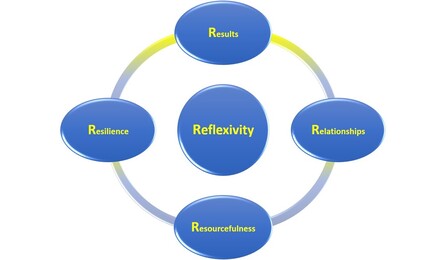 People sometimes ask if I have a guiding framework for fields of practice that range from individual and team coaching to organisation development. To be honest, it’s difficult to pin down definitively without becoming simplistic. After all, we work with people, cultures, systems and contexts that are dynamically complex. Different people, situations and times call for different interventions. Here-and-now presence, openness, curiosity and trust are prerequisite conditions for successful outcomes. That said, I often hold 5 x Rs in mind as potential areas for attention. Each R represents a different and inter-related dimension of experience, awareness and practice that commonly influences a client’s inspiration and effectiveness. The Rs are: Results, Relationships, Resourcefulness, Resilience and Reflexivity (sometimes known as ‘critical reflective practice’ or ‘praxis’). I may explore and apply these dimensions with a client at different levels ranging from intra/inter-personal to organisational. Results focuses on who or what is most important to a client and other key stakeholders and taps into e.g. vision, values, purpose, strategy, plans and outcomes. Relationships focuses on the quality of client contact with and between key stakeholders and taps into e.g. ethics, cultures, systems, synergies and dependencies. Resourcefulness focuses on solutions, strengths and opportunities in the client/environment and taps into e.g. spirituality, talent, creativity, innovation and networks. Resilience focuses on client health, wellbeing and sustainability and taps into e.g. motivation, engagement, patterns-trends, agility and flow. Reflexivity focuses on the client’s critical self- and situational awareness, stance and actions and taps into e.g. assumptions, constructs, influences, behaviours and decisions. I place the latter at the centre of this model because, at best, it radically questions, challenges and guides all other dimensions. It lays at the heart of transformational change. What frameworks do you use and find most useful? |
Nick WrightI'm a psychological coach, trainer and OD consultant. Curious to discover how can I help you? Get in touch! 
Like what you read? Simply enter your email address below to receive regular blog updates!


|
 RSS Feed